Next Generation Firewall (NGFW) Explained: Features, Benefits & How It Works
Cyber threats are becoming more sophisticated, and traditional network security solutions often need additional capabilities to identify and respond to modern attacks. Organizations today need security solutions that can inspect network traffic, identify applications, detect threats, and enforce security policies based on users and context.
This is where a Next Generation Firewall (NGFW) becomes important.
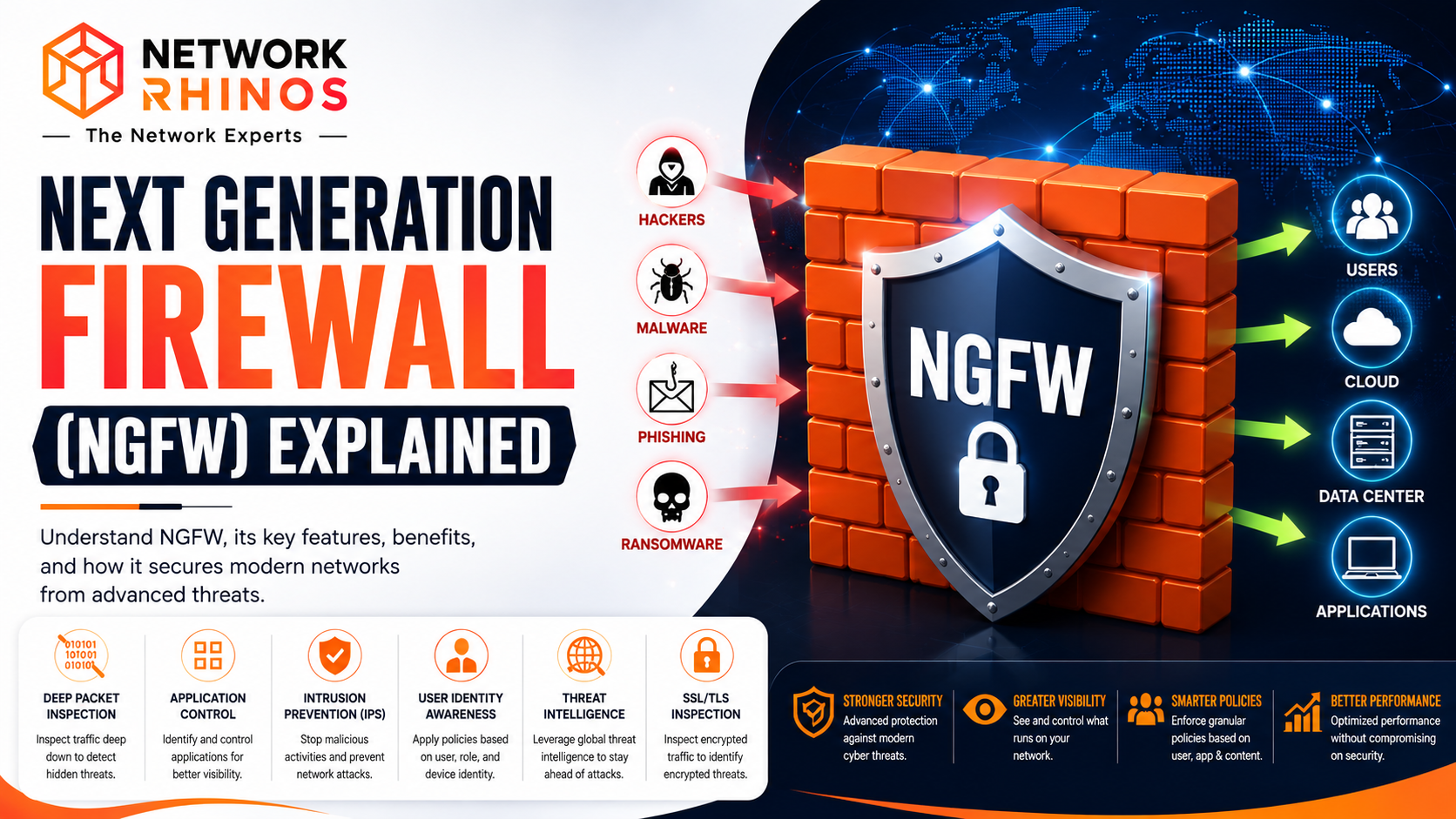
A Next Generation Firewall combines traditional firewall capabilities with advanced security technologies such as deep packet inspection, application awareness, intrusion prevention, threat intelligence, user identification, and advanced threat detection.
But what exactly is NGFW, how does it work, and how is it different from a traditional firewall?
Let’s explore.
What Is a Next Generation Firewall (NGFW)?
A Next Generation Firewall (NGFW) is an advanced network security solution designed to monitor, inspect, control, and protect network traffic beyond the capabilities of a traditional firewall.
A traditional firewall primarily controls traffic based on information such as:
- Source IP address
- Destination IP address
- Port number
- Protocol
- Network connection state
An NGFW goes further by understanding applications, users, content, and potential threats within network traffic.
This enables organizations to implement more detailed security policies.
For example, instead of simply allowing HTTPS traffic through port 443, an NGFW can potentially identify the application using that connection and apply a policy based on the application, user, device, or security risk.
In simple terms:
Traditional firewall:
“Is this network connection allowed?”
NGFW:
“What is this traffic, which application generated it, who is using it, and does it contain a potential threat?”
How Does a Next Generation Firewall Work?
A Next Generation Firewall works by inspecting and analyzing network traffic before deciding whether the traffic should be allowed, blocked, or subjected to additional security controls.
A simplified NGFW traffic inspection process looks like this:
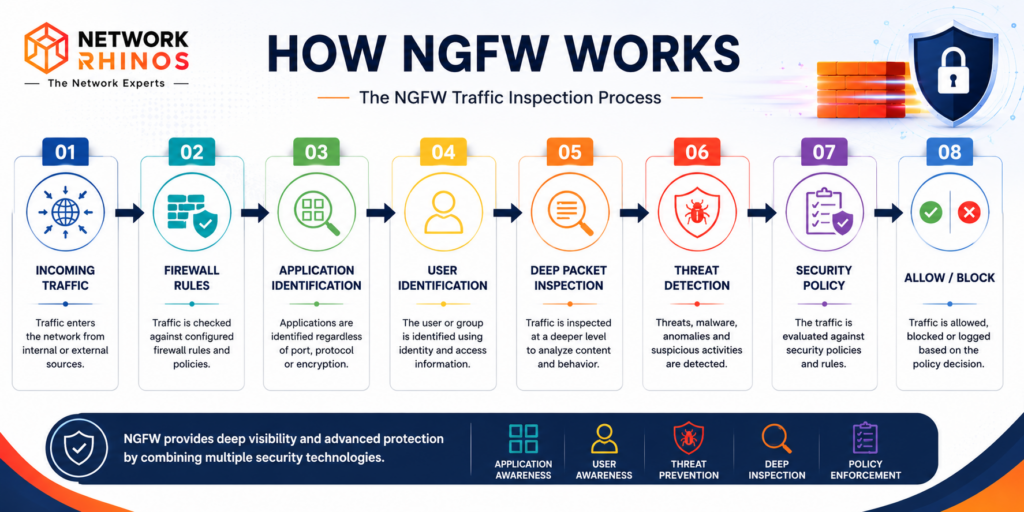
Depending on the platform and configuration, NGFWs can combine multiple security technologies to analyze traffic.
1. Traffic Inspection
The NGFW receives network traffic entering or leaving the network.
It examines traffic according to configured security policies.
2. Application Identification
Instead of relying only on ports and protocols, NGFW technology can identify applications and application traffic.
For example, an administrator may create policies controlling specific applications rather than simply allowing or blocking an entire port.
3. User Identification
Modern firewalls can associate network activity with users or groups.
This allows organizations to create policies such as:
- Employees can access approved applications.
- Administrators receive broader privileges.
- Guest users receive restricted access.
- High-risk applications are blocked.
4. Deep Packet Inspection
Deep Packet Inspection (DPI) examines network packets beyond basic headers.
It can provide greater visibility into traffic and help security systems identify suspicious patterns, applications, and potentially malicious content.
5. Threat Detection
NGFWs can integrate security technologies designed to detect threats such as malware, exploits, suspicious traffic, and unauthorized activity.
6. Policy Enforcement
After analyzing traffic, the firewall applies its security policies.
Depending on the configuration, it may:
- Allow the traffic
- Block the traffic
- Log the activity
- Inspect the traffic further
- Generate an alert
Key Features of a Next Generation Firewall
The exact capabilities vary between vendors and products, but several features are commonly associated with NGFW technology.
1. Stateful Firewall
NGFWs retain the traditional firewall’s ability to track active network connections.
This allows the firewall to understand whether traffic belongs to an established connection and apply appropriate rules.
2. Deep Packet Inspection
Deep Packet Inspection allows security devices to examine network traffic in greater detail.
Rather than relying exclusively on packet headers, inspection can provide visibility into the content and characteristics of traffic.
This helps security teams identify suspicious or unauthorized activity.
3. Application Awareness and Control
One of the major advantages of NGFW is application awareness.
An NGFW can identify applications and allow administrators to create policies around them.
For example, organizations might:
- Allow business applications
- Restrict unauthorized applications
- Block risky applications
- Monitor application usage
This provides more granular control than simple port-based filtering.
4. Intrusion Prevention System (IPS)
Many NGFW platforms integrate Intrusion Prevention System (IPS) capabilities.
IPS monitors traffic for patterns associated with known attacks or suspicious behavior and can take action to prevent threats.
This adds another security layer beyond basic firewall filtering.
5. User and Identity Awareness
NGFWs can integrate with identity and directory services to associate network traffic with users.
This makes it possible to create security policies based on:
- User
- Department
- Group
- Role
- Device
For example, an organization could apply different internet access policies to employees, administrators, contractors, and guests.
6. Threat Intelligence
Threat intelligence can help security systems identify potentially malicious infrastructure and activity.
NGFW platforms may use threat intelligence feeds to improve their ability to identify:
- Malicious IP addresses
- Suspicious domains
- Known attack infrastructure
- Malware-related activity
7. SSL/TLS Inspection
A significant amount of modern internet traffic is encrypted.
While encryption protects legitimate communications, it can also make security inspection more challenging.
Depending on configuration and applicable privacy requirements, NGFWs can perform SSL/TLS inspection to analyze encrypted traffic for potential threats.
Organizations need to carefully consider performance, privacy, compliance, and certificate management when deploying this capability.
8. URL and Content Filtering
NGFW platforms may also provide web filtering capabilities.
Organizations can use these controls to restrict access to categories or websites that violate company policies or create security risks.
Examples include:
- Malicious websites
- Phishing websites
- Unapproved content
- High-risk categories
Benefits of a Next Generation Firewall
Why are organizations moving beyond traditional firewall technology?
Here are some of the key benefits.
Better Network Visibility – NGFW provides greater visibility into applications, users, devices, and network traffic.
Improved Threat Detection – The integration of multiple security technologies can help identify a wider range of threats.
Application-Level Control – Security administrators can create policies based on applications instead of relying only on IP addresses and ports.
User-Based Security Policies – Organizations can apply different security rules to different users or groups.
Centralized Security – Multiple security capabilities can be brought together into a single platform, simplifying security management.
Better Security Policy Enforcement – Organizations can create more granular policies based on application, user, device, traffic, and threat context.
NGFW vs Traditional Firewall
One of the most common questions is:
Difference between a traditional firewall and a Next Generation Firewall:
| Feature | Traditional Firewall | NGFW |
|---|---|---|
| IP filtering | ✓ | ✓ |
| Port filtering | ✓ | ✓ |
| Stateful inspection | ✓ | ✓ |
| Application awareness | Limited/No | ✓ |
| Deep packet inspection | Limited | ✓ |
| Intrusion prevention | Usually separate | Often integrated |
| User identification | Limited | ✓ |
| Threat intelligence | Limited | ✓ |
| Advanced threat detection | Limited | ✓ |
| Granular application policies | Limited | ✓ |
The key difference is visibility and depth of inspection.
A traditional firewall primarily focuses on controlling network connections.
An NGFW combines traditional firewall functions with additional security controls designed to understand applications, users, traffic, and threats.
NGFW vs Traditional Firewall: Which One Should You Choose?
There is no universal answer.
The right solution depends on factors such as:
- Network size
- Security requirements
- Number of users
- Applications being used
- Compliance requirements
- Cloud connectivity
- Remote workforce
- Existing security infrastructure
- Budget
- IT team’s expertise
For smaller environments with straightforward security requirements, a traditional firewall may still be appropriate.
Organizations dealing with complex applications, distributed networks, advanced threats, and large numbers of users may benefit from NGFW capabilities.
Where Is NGFW Used?
Next Generation Firewalls are commonly used across different types of environments.
Enterprise Networks: Large organizations can use NGFW to control traffic between users, applications, servers, and network segments.
Data Centers: NGFW can help protect critical workloads and control communication between different network zones.
Branch Offices: Organizations can deploy firewall security at branch locations to protect local users and devices.
Cloud Environments: Modern firewall technologies can also be integrated into cloud and hybrid environments, depending on the vendor and architecture.
Educational Institutions: Schools, colleges, and universities can use firewall policies to control internet access and protect institutional networks.
NGFW and Network Segmentation
Network segmentation is another important area where NGFW technology can be useful.
Instead of allowing unrestricted communication across an entire network, organizations can divide the environment into different security zones.
For example:
Users → Firewall → Application Servers → Firewall → Database
Policies can then control which systems are allowed to communicate.
This can help reduce unnecessary access and limit the potential impact of a security incident.
Challenges of Implementing NGFW
Although NGFW offers advanced capabilities, implementing one requires careful planning.
Configuration Complexity
More security features mean more policies and configuration options.
Performance
Advanced inspection, particularly encrypted traffic inspection, can require significant processing resources.
Cost
NGFW platforms can involve higher licensing, hardware, and operational costs compared with basic firewall solutions.
Skilled Professionals
Organizations need trained professionals who understand firewall policies, routing, security architecture, applications, and troubleshooting.
Policy Management
Poorly designed firewall rules can create security gaps or unnecessarily restrict legitimate traffic.
How to Configure an NGFW?
A typical NGFW deployment can follow these steps:
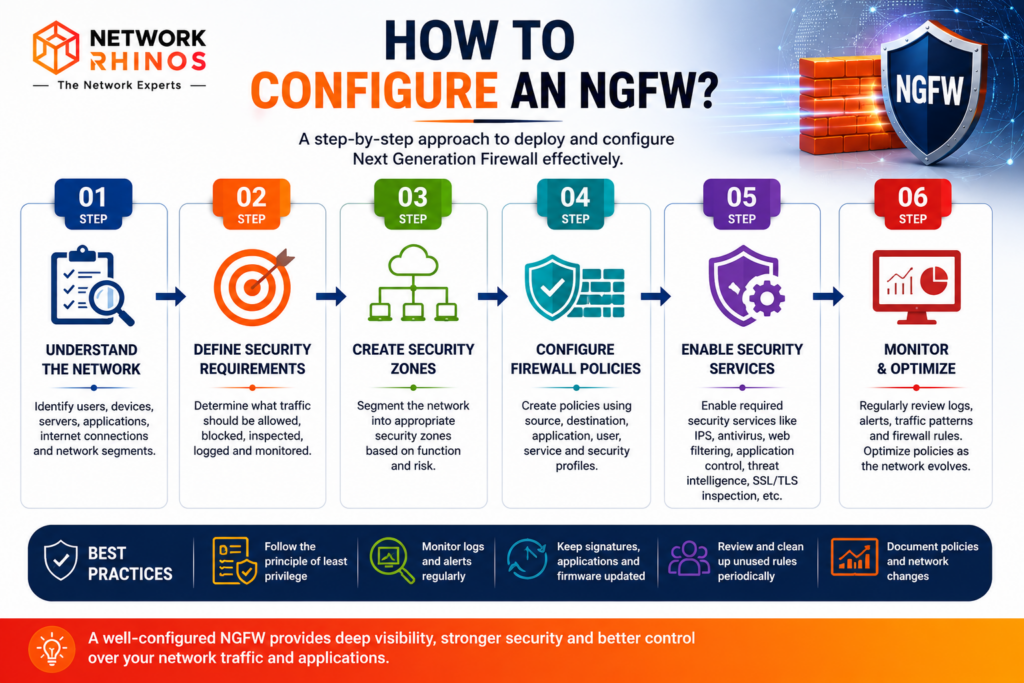
Step 1: Understand the Network
Identify:
- Users
- Devices
- Servers
- Applications
- Internet connections
- Network segments
Step 2: Define Security Requirements
Determine what traffic should be:
- Allowed
- Blocked
- Inspected
- Logged
- Monitored
Step 3: Create Security Zones
Separate networks into appropriate security zones based on their function and risk.
Step 4: Configure Firewall Policies
Create policies based on:
- Source
- Destination
- Application
- User
- Service
- Security profile
Step 5: Enable Security Services
Depending on requirements, configure appropriate capabilities such as:
- IPS
- Antivirus/malware protection
- Web filtering
- Application control
- Threat intelligence
- SSL/TLS inspection
Step 6: Monitor and Optimize
Regularly review logs, alerts, traffic patterns, and firewall rules.
Security policies should evolve as the network changes.
Is NGFW Important for Network Security Professionals?
Yes.
As networks become more distributed and applications become increasingly cloud-based, network security professionals need to understand more than traditional IP addressing and port-based firewall rules.
Knowledge of NGFW can be valuable for professionals working with:
- Network security
- Enterprise networking
- Cybersecurity
- Firewall administration
- Security operations
- Cloud security
- Network infrastructure
For aspiring network and cybersecurity professionals, understanding firewall policies, NAT, routing, VPNs, application control, IPS, threat detection, and traffic inspection provides a strong foundation.
Final Thoughts
A Next Generation Firewall (NGFW) goes beyond traditional packet filtering by providing deeper visibility and more advanced security controls.
Its ability to combine stateful firewalling, application awareness, deep packet inspection, identity awareness, intrusion prevention, threat intelligence, and other security technologies makes it an important component of modern network security architectures.
However, simply deploying an NGFW does not automatically guarantee network security. Effective protection depends on proper architecture, well-designed policies, regular monitoring, timely updates, and skilled security professionals.
For anyone pursuing a career in networking or cybersecurity, understanding how NGFW works and how it differs from traditional firewall technology is an important step toward working with modern enterprise security environments.
Frequently Asked Questions
What is a Next Generation Firewall?
A Next Generation Firewall (NGFW) is an advanced firewall that combines traditional traffic filtering with capabilities such as application awareness, deep packet inspection, intrusion prevention, identity awareness, and threat detection.
What does NGFW stand for?
NGFW stands for Next Generation Firewall.
What is the difference between NGFW and a traditional firewall?
A traditional firewall primarily controls network traffic using IP addresses, ports, protocols, and connection states. NGFW adds deeper inspection and security capabilities such as application control, IPS, user awareness, and threat intelligence.
Is NGFW the same as a firewall?
NGFW is a type of firewall, but it provides more advanced inspection and security capabilities than a basic traditional firewall.
What are the main features of NGFW?
Common features include stateful inspection, application awareness, deep packet inspection, IPS, identity awareness, threat intelligence, URL filtering, and SSL/TLS inspection.
Why is NGFW important?
NGFW helps organizations gain greater visibility and control over network traffic while adding multiple layers of security against modern threats.
Is NGFW useful for cybersecurity professionals?
Yes. Understanding NGFW technology is useful for professionals working in networking, cybersecurity, firewall administration, SOC operations, and network security.