Why Python Is Still One of the Most Useful Programming Languages to Learn?
Have you ever wondered how websites work, how apps process information, how companies analyze millions of records, or how machines can learn from data?
Behind many of these technologies, you will find programming.
There are many programming languages available today, but Python continues to be one of the most useful and widely learned programming languages. It is used by students, developers, data analysts, network engineers, cybersecurity professionals, researchers, and many other technology professionals.
But why has Python remained so popular when there are so many newer programming languages?
The answer is simple: Python is easy to learn, flexible, powerful, and useful in many different areas of technology.
Whether you are a school student taking your first steps into programming or a professional looking to add a new skill, Python can be a very practical language to learn.
What Is Python?
Python is a high-level, general-purpose programming language.
That may sound complicated, but the idea is actually quite simple.
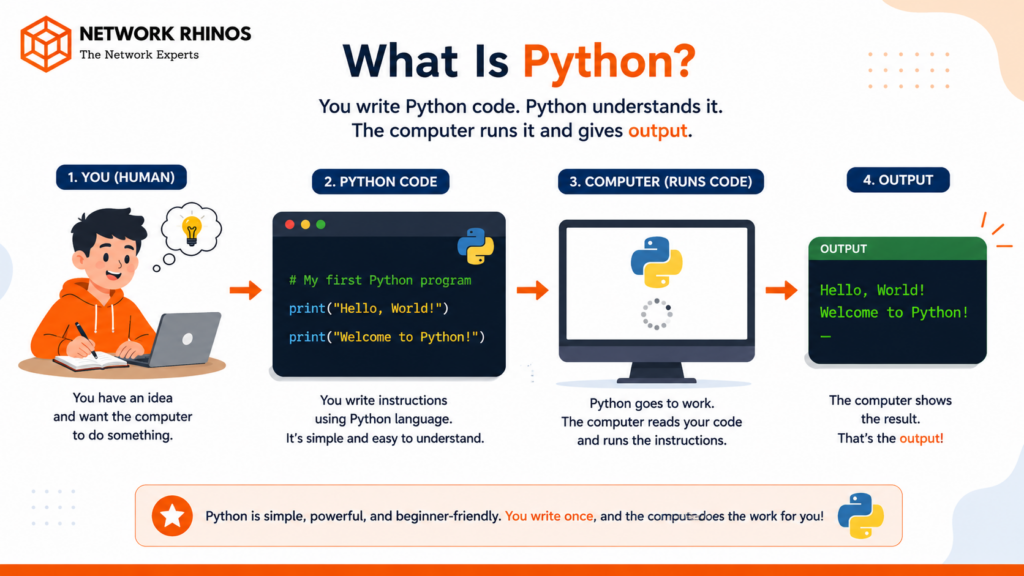
A programming language is a way for humans to give instructions to computers. Just like we use languages such as English or Tamil to communicate with people, programmers use languages such as Python to communicate with computers.
For example, a simple Python program can look like this:
print("Hello, World!")When you run this program, the computer displays:
Hello, World!
That simplicity is one of the reasons Python is so popular among beginners.
You don’t need to understand hundreds of complicated symbols before writing your first program. You can start with small programs and gradually learn more advanced concepts.
Why Is Python So Easy to Learn?
One of Python’s biggest advantages is its simple and readable syntax.
Consider this example:
name = "Rahul"
print("Hello", name)
Even if you are completely new to programming, you can probably understand what this code is trying to do.
It stores a name and then displays a greeting.
Python was designed with readability in mind. This makes it easier for beginners to understand what their code is doing.
This doesn’t mean Python is only for beginners.
That’s an important point.
Python may be easy to start with, but it is powerful enough to be used for serious professional projects.
- A student can use Python to create a simple calculator.
- A developer can use Python to build web applications.
- A data scientist can use Python to analyze huge datasets.
- A cybersecurity professional can use Python to automate security tasks.
- A network engineer can use Python to automate network devices.
One language can be useful at many different levels.
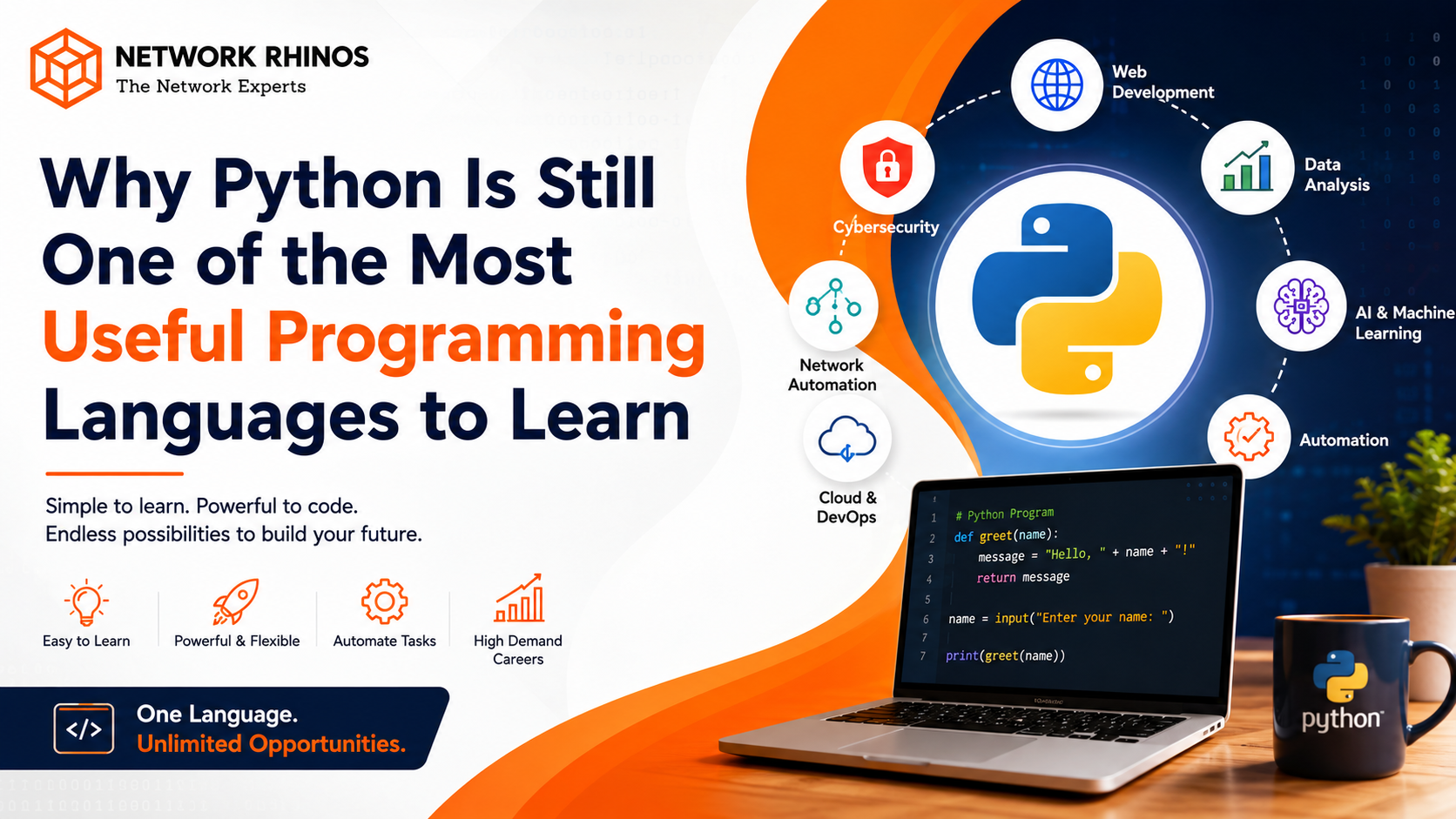
Python Can Be Used for Many Different Things
Another major reason Python remains popular is its versatility.
Some programming languages are strongly associated with a particular type of development. Python, on the other hand, is used across many different technology fields.
Let’s look at some of them.
1. Web Development
Python can be used to build websites and web applications.
Popular Python frameworks such as Django and Flask help developers create web applications without having to build everything from scratch.
For example, Python can be used to handle:
- User registrations
- Login systems
- Database operations
- Online forms
- APIs
- Business applications
So, if you are interested in creating websites that do more than just display information, Python can be a useful skill.
2. Data Analysis
We generate enormous amounts of data every day.
Every online purchase, search, login, transaction, and interaction can generate information.
But raw data isn’t very useful unless we can understand it.
Python makes it easier to work with large amounts of data.
Libraries such as Pandas and NumPy are commonly used for data processing and analysis.
For example, imagine a school has the marks of 10,000 students.
Instead of manually calculating averages and comparing results, a Python program could process the data within seconds.
That’s the power of programming.
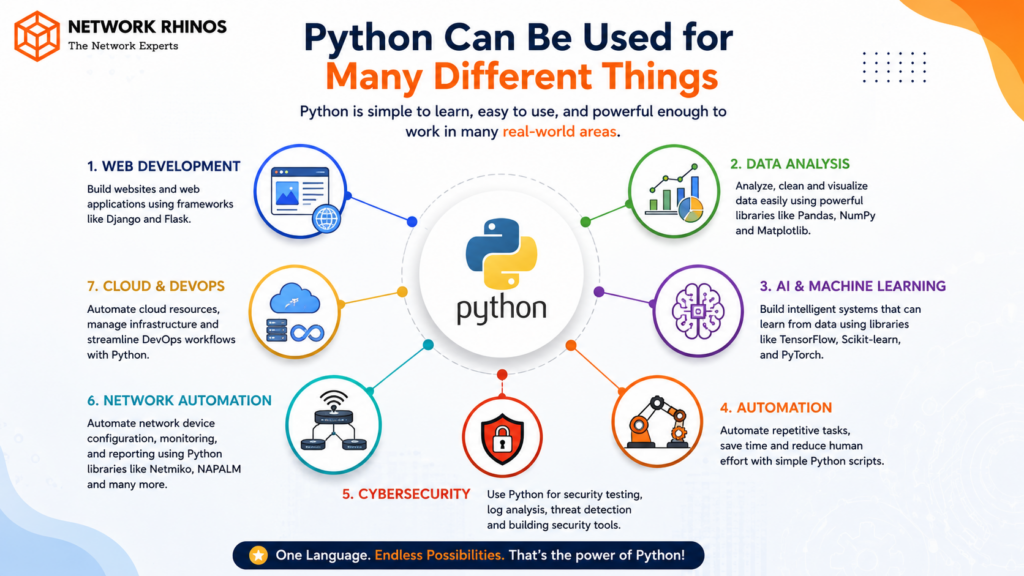
3. Artificial Intelligence and Machine Learning
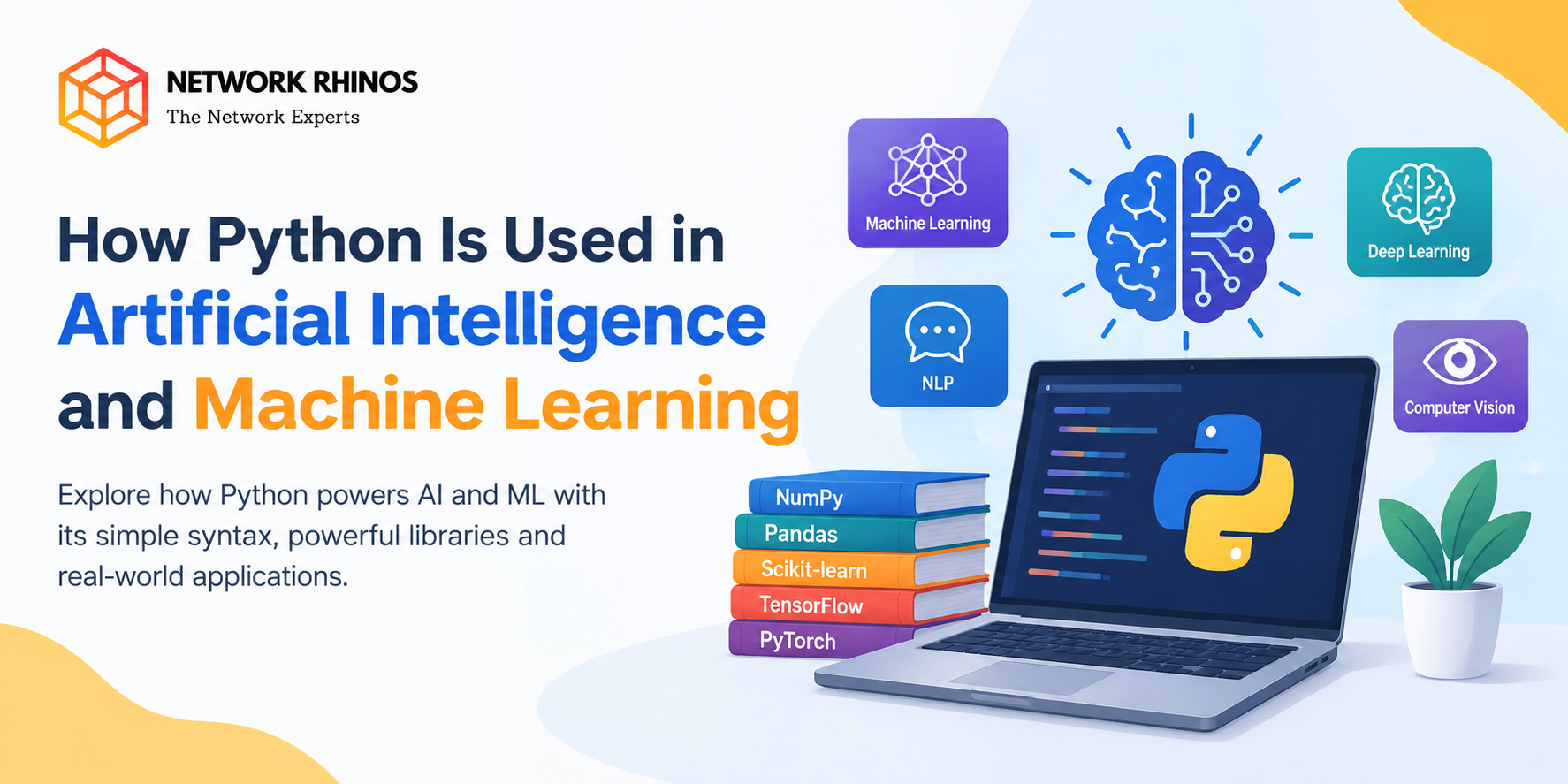
Artificial intelligence has become one of the biggest areas of technology, and Python plays a major role in it.
Python is widely used for:
- Machine learning
- Artificial intelligence
- Natural language processing
- Computer vision
- Data preparation
- Model development
Popular libraries and frameworks make it easier for developers and researchers to experiment with AI technologies.
This is one reason Python continues to attract new learners.
If AI interests you, learning Python can give you a strong foundation before moving into machine learning and artificial intelligence.
4. Automation
Imagine doing the same task 500 times.
It could be renaming files, checking information, moving data between systems, generating reports, or performing repetitive calculations.
Doing this manually can take hours.
Python can automate many repetitive tasks.
For example, instead of manually renaming hundreds of files, you could write a Python script that does it automatically.
This is called automation.
Automation is valuable because it can save time and reduce the number of repetitive manual tasks people have to perform.
Python for Network Engineers
This is particularly interesting for students and professionals interested in networking.
Networking isn’t only about configuring routers and switches manually anymore.
Modern networks can contain hundreds or even thousands of devices.
Imagine a company has 500 network switches.
If an engineer needs to make the same change on every switch, doing it manually would take a lot of time.
Python can help automate such tasks.
Python can be used for:
- Network automation
- Device configuration
- Collecting network information
- Monitoring systems
- Automating repetitive commands
- Working with network APIs
- Generating reports
This is why Python for network engineers has become an important skill to explore.
If you’re already learning networking technologies such as CCNA or CCNP, adding Python to your skill set can help you understand network automation.
You don’t have to become a full-time software developer.
Instead, you can use Python as a tool to make your networking work faster and more efficient.
Python and Cybersecurity
Python is also useful in cybersecurity.
Cybersecurity professionals often need to analyze information, automate tasks, work with files, process logs, and interact with different systems.
Python can help with many of these activities.
For example, a cybersecurity professional might write a Python script to:
- Analyze log files
- Process security data
- Automate repetitive tasks
- Check systems
- Work with APIs
- Perform data analysis
- Build security-related tools
However, learning Python alone does not make someone a cybersecurity expert.
You also need to understand areas such as networking, operating systems, security concepts, and ethical hacking.
Think of Python as one tool in a larger cybersecurity toolbox.
Python Is Useful for Small Projects Too
You don’t need to work at a large technology company to benefit from Python.
Python is excellent for small personal projects.
A beginner could create:
- A calculator
- A number guessing game
- A simple quiz
- A password generator
- A to-do list
- A basic chatbot
- A file organizer
- A simple expense tracker
These projects may look small, but they teach important programming concepts.
For example, while building a quiz application, you may learn about:
- Variables
- Conditions
- Loops
- Functions
- Lists
- User input
These concepts form the foundation of programming.
Python Has a Huge Collection of Libraries
One reason Python is so powerful is its ecosystem of libraries and frameworks.
Think of a library as a collection of ready-made code that other developers have created for a particular purpose.
Instead of building everything from the beginning, you can use these tools to solve common problems.
For example:
| Area | Examples |
|---|---|
| Data Analysis | Pandas, NumPy |
| Machine Learning | Scikit-learn |
| Web Development | Django, Flask |
| Visualization | Matplotlib |
| Automation | Selenium and other automation tools |
| Networking | Netmiko, NAPALM and related tools |
This ecosystem saves developers a great deal of time.
It also means that when you learn Python, you’re not just learning one programming language. You’re gaining access to a much larger technology ecosystem.
You Don’t Need to Be a Mathematics Expert to Start Python
This is a common misconception among beginners.
Some people think:
“I am not good at mathematics, so programming isn’t for me.”
That’s not necessarily true.
Basic programming does involve logic and problem-solving, but you don’t need advanced mathematics to write your first Python program.
For example:
age = 15

if age >= 18:
    print("Adult")
else:
    print("Not an adult")
This is mainly about understanding a condition.
Programming is often about breaking a big problem into smaller steps.
If you can learn to think logically and patiently solve problems, you can start learning Python.
Python Helps You Learn Problem-Solving
One of the most valuable things you gain from learning Python isn’t just the ability to write code.
It is the ability to think through a problem.
Suppose you want to create a program that calculates the average marks of five subjects.
You need to think:
- How will I collect the marks?
- How will I add them?
- How will I calculate the average?
- How will I display the result?
Programming teaches you to break a problem into smaller steps.
This way of thinking can be useful even outside programming.
Python Has a Large Learning Community
When you start learning something new, getting stuck is normal.
You might write a program and receive an error message.
You might not understand why the error occurred.
You might spend 20 minutes trying to fix it and still have no idea what went wrong.
This happens to beginners and experienced developers alike.
Python has a large global community of learners and developers who create:
- Tutorials
- Documentation
- Courses
- Examples
- Projects
- Discussion forums
- Learning resources
This makes it easier for beginners to find explanations and examples when they need help.
But remember: don’t simply copy code from the internet.
Try to understand why the code works.
That is where real learning happens.
Python Can Open Different Career Paths
Learning Python doesn’t automatically guarantee a job.
However, it can become a valuable skill when combined with knowledge in a specific technology area.
For example:
Python + Networking
→ Network Automation
Python + Data
→ Data Analysis
Python + AI
→ Machine Learning / AI
Python + Web Development
→ Backend Development
Python + Cybersecurity
→ Security Automation and Scripting
Python + Cloud
→ Cloud Automation and DevOps
This is an important way to think about learning programming.
Don’t just ask:
“What programming language should I learn?”
Also ask:
“What do I want to build or what technology field interests me?”
Then use Python as one of the tools that helps you get there.
Is Python Still Worth Learning?
With so many new technologies appearing every year, it’s reasonable to ask whether Python is still worth learning.
The answer is yes.
Python has remained relevant because it solves real problems.
It is easy enough for beginners to start with, while also being powerful enough for professional use.
Its applications span across:
- Software development
- Data analysis
- Artificial intelligence
- Machine learning
- Automation
- Networking
- Cybersecurity
- Cloud computing
- Research
- Education
That combination of simplicity and flexibility is difficult to ignore.
Should School Students Learn Python?
Absolutely.
In fact, starting early can be an advantage.
You don’t need to begin with complicated applications or advanced programming concepts.
Start small.
Write a program that asks for your name.
Then create a calculator.
Then build a quiz.
Then try a small game.
As you become comfortable, move on to larger projects.
The goal shouldn’t be to memorize Python commands.
The goal should be to understand how to solve problems using code.
How Should a Beginner Start Learning Python?
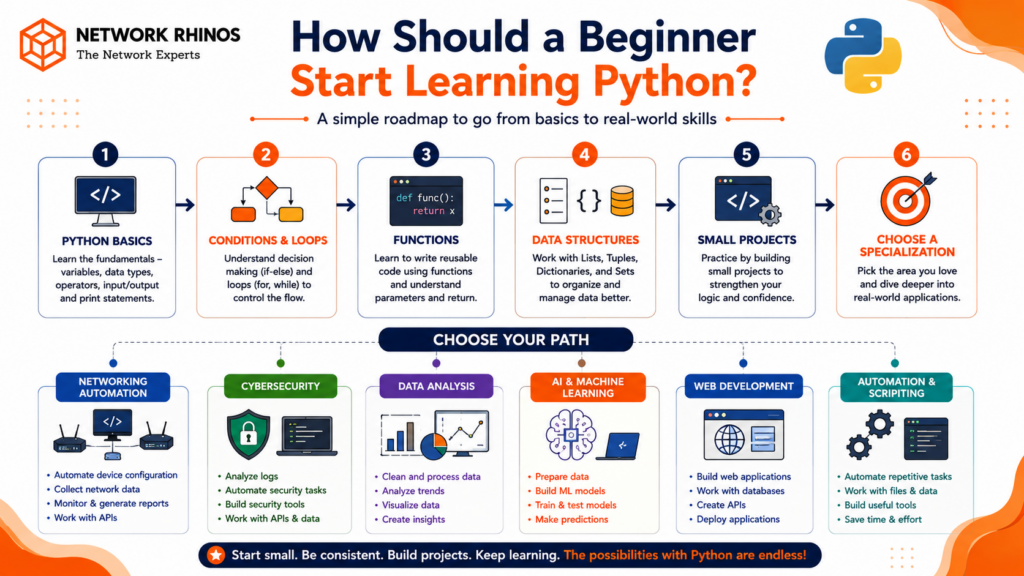
If you’re completely new to programming, don’t try to learn everything at once.
A simple learning path could look like this:
Step 1: Learn the Basics
Start with:
- Variables
- Data types
- Operators
- Input and output
- Conditions
- Loops
Step 2: Understand Functions
Learn how functions work and why programmers use them.
Step 3: Learn Data Structures
Understand:
- Lists
- Tuples
- Dictionaries
- Sets
Step 4: Practice Small Programs
Build simple projects rather than only watching tutorials.
Step 5: Choose an Area
Once you understand the basics, decide what interests you.
For example:
Networking → Python network automation
Data → Data analysis
AI → Machine learning
Web → Web development
Cybersecurity → Security scripting and automation
Step 6: Build Projects
Projects are where your knowledge starts becoming practical.
Don’t worry if your first project looks simple.
Every experienced programmer started somewhere.
Python vs Learning Multiple Programming Languages
Beginners sometimes make the mistake of trying to learn five programming languages at the same time.
This usually creates confusion.
You don’t need to know ten programming languages to become good at programming.
It is better to become comfortable with one language first.
Python is a good choice because its concepts can later help you understand other programming languages more easily.
Once you understand variables, loops, conditions, functions, and problem-solving in one language, learning another language becomes less intimidating.
The Most Important Thing Is Not the Language
Here’s something worth remembering.
Python is a tool.
The real skill is knowing how to use that tool to solve problems.
A person who knows 100 Python commands but cannot solve a simple problem may struggle however Someone who understands programming logic and can find solutions will continue improving.
So don’t focus only on memorizing syntax.
Ask questions like:
- Why does this code work?
- What happens if I change this?
- Can I solve this problem differently?
- Can I automate this task?
- Can I make this program faster?
- Can I make the code easier to understand?
That’s how you move from simply learning Python to actually becoming a programmer.
Conclusion
Python has been around for many years, but it continues to be one of the most useful programming languages to learn.
Its biggest strength isn’t just that it is easy.
Its real strength is how many things you can do with it.
- A school student can use Python to learn programming.
- A college student can use it to build projects.
- A developer can use it to create applications.
- A data analyst can use it to work with data.
- A network engineer can use it for automation.
- A cybersecurity professional can use it for scripting.
- An AI researcher can use it to develop and test models.
That’s what makes Python so valuable.
You don’t have to decide today exactly what you want to become. Start by learning the fundamentals, practice regularly, build small projects, and gradually explore the areas that interest you.
Python can be your first programming language, but it doesn’t have to be your last skill. It can be the starting point for a much larger technology journey.
Want to Learn Python?
If you’re looking for structured Python training with practical learning, Network Rhinos can help you build your Python fundamentals and gradually move toward real-world applications. Whether you’re a beginner or someone looking to add Python to your networking, automation, or IT skill set, learning the fundamentals properly is a great place to start.