How Python Is Used in Artificial Intelligence and Machine Learning
Artificial Intelligence (AI) and Machine Learning (ML) are becoming an important part of modern technology. From chatbots and recommendation systems to self-driving cars and fraud detection, AI and ML are being used in many industries.
One programming language that has become very popular in these fields is Python. Its simple syntax, large collection of libraries, and strong community support make it a preferred choice for students, developers, data scientists, and AI professionals.
If you are planning to build a career in AI or Machine Learning, learning Python can give you a strong foundation.
What Is Python?
Python is a high-level, general-purpose programming language known for its simple and readable syntax. Beginners can learn Python more easily compared to many other programming languages.
Python is used for web development, automation, data analysis, software development, cybersecurity, Artificial Intelligence, and Machine Learning.
One of the biggest advantages of Python is its large ecosystem of libraries and frameworks. Developers can use these tools to perform complex tasks without writing everything from scratch.
Why Is Python Popular for AI and Machine Learning?
There are several reasons why Python is widely used for AI and Machine Learning projects.
1. Simple and Easy-to-Understand Syntax
Python code is relatively easy to read and write. This is especially helpful for beginners who are starting their journey in programming and AI.
For example, Python allows developers to write a simple program with fewer lines of code compared to some other programming languages.
This makes it easier for AI and ML developers to focus on solving problems instead of spending too much time dealing with complicated programming syntax.
2. Large Number of AI and ML Libraries
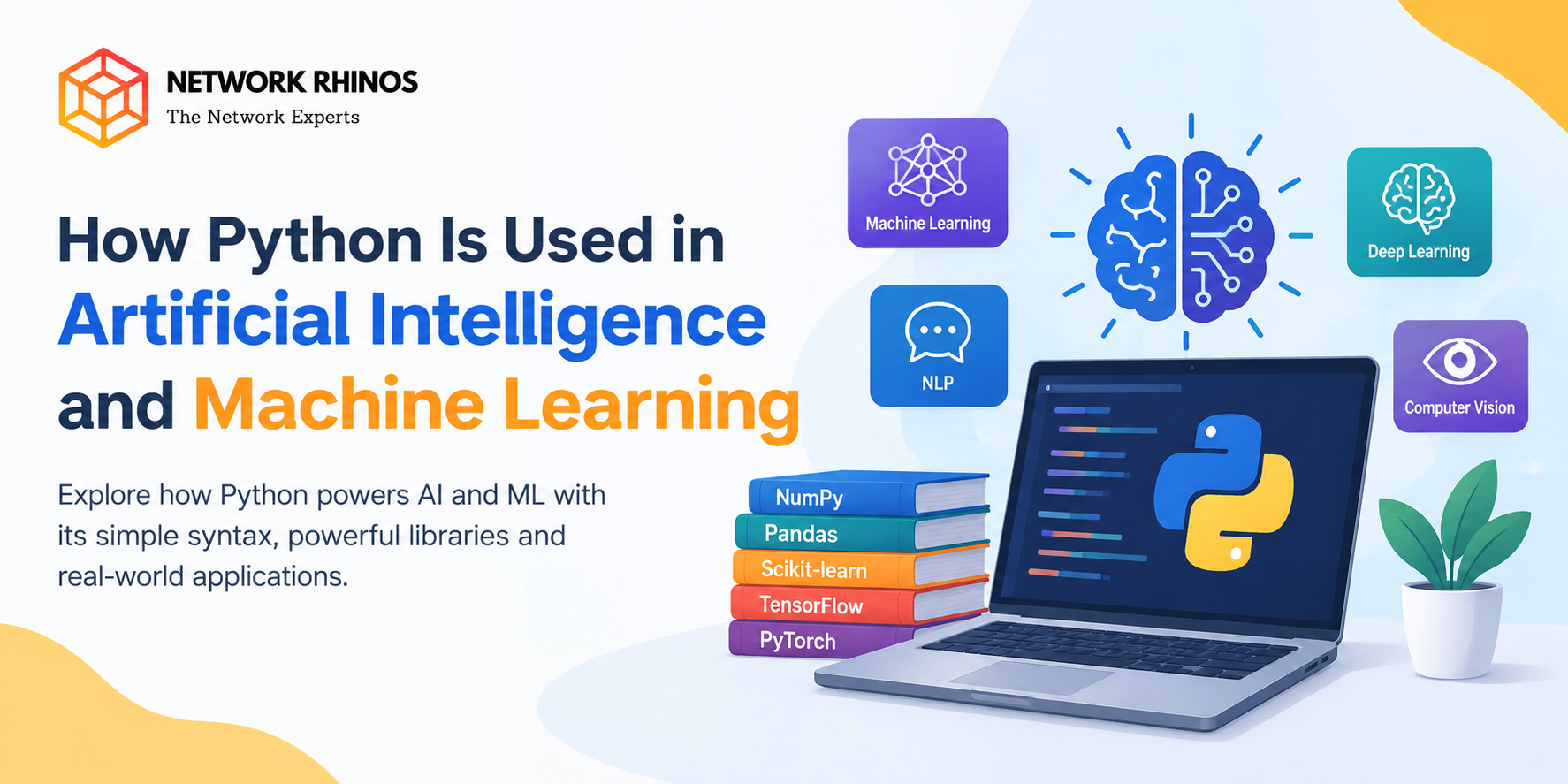
Python has many libraries designed for data analysis, Machine Learning, deep learning, and scientific computing.
Some commonly used Python libraries include:
- NumPy – Used for numerical calculations and working with arrays.
- Pandas – Used for data cleaning, analysis, and manipulation.
- Matplotlib – Used to create charts and visualizations.
- Scikit-learn – Used for traditional Machine Learning algorithms.
- TensorFlow – Used for developing and training Machine Learning and deep learning models.
- PyTorch – A popular framework for deep learning and neural network development.
These libraries reduce development time and make it easier to build AI applications.
How Python Is Used in Artificial Intelligence?
Python plays an important role in different areas of Artificial Intelligence.
Natural Language Processing
Natural Language Processing (NLP) allows computers to understand and process human language. Applications such as chatbots, virtual assistants, language translation, and sentiment analysis use NLP techniques. Python provides several tools and libraries that developers can use to process text and build language-based applications.
For example, a company can use Python to develop a chatbot that answers common customer questions automatically.
Computer Vision
Computer Vision enables computers to understand information from images and videos.
Python can be used to develop applications for:
- Face detection
- Object detection
- Image classification
- Medical image analysis
- Security monitoring
- Image recognition
Libraries and frameworks such as OpenCV, TensorFlow, and PyTorch are commonly used in computer vision projects.
Robotics
AI-powered robots need to process information from sensors, cameras, and other devices. Python can be used to develop software that helps robots analyze data, make decisions, and perform specific tasks. Although robotics may also require languages such as C or C++, Python is often useful for AI algorithms, prototyping, testing, and data processing
How Python Is Used in Machine Learning?
Machine Learning is a branch of Artificial Intelligence where computers learn patterns from data and use those patterns to make predictions or decisions.
Python is widely used throughout the Machine Learning workflow.
1. Collecting Data
Machine Learning models need data to learn from. Python can be used to collect data from databases, files, APIs, and other sources. The collected data can then be prepared for analysis.
2. Cleaning and Preparing Data
Real-world data is often incomplete or inconsistent. It may contain missing values, duplicate records, or incorrect information. Python libraries such as Pandas help developers clean and organize this data before using it to train a Machine Learning model.
3. Data Analysis
Before creating a Machine Learning model, developers need to understand the available data. Python can be used to analyze datasets and identify patterns, trends, and relationships. Visualization libraries such as Matplotlib can also help developers understand data through charts and graphs.
4. Building Machine Learning Models
Python can be used to implement different Machine Learning algorithms.
For example, developers can build models for:
- Predicting sales
- Detecting spam emails
- Customer segmentation
- Fraud detection
- Recommendation systems
- Predicting customer behavior
Scikit-learn provides many commonly used algorithms and tools for Machine Learning.
5. Training and Testing Models
After selecting an algorithm, the model needs to be trained using available data. Python libraries make it easier to divide datasets into training and testing data, train models, evaluate their performance, and improve them when necessary.
6. Deep Learning
Deep Learning is a specialized area of Machine Learning that uses neural networks to learn from large amounts of data. Python is widely used for Deep Learning because of frameworks such as TensorFlow and PyTorch. These frameworks can be used to develop applications involving images, speech, text, recommendation systems, and other complex data.
Python Libraries Used in AI and Machine Learning
Here are some popular Python libraries and frameworks used in AI and Machine Learning:
| Python Tool | Common Use |
|---|---|
| NumPy | Numerical computing |
| Pandas | Data analysis and data cleaning |
| Matplotlib | Data visualization |
| Scikit-learn | Machine Learning |
| TensorFlow | Machine Learning and Deep Learning |
| PyTorch | Deep Learning and neural networks |
| OpenCV | Computer vision |
| SciPy | Scientific computing |
Learning these tools can help students gradually move from basic Python programming to more advanced AI and Machine Learning projects.
Examples of AI and ML Applications Built Using Python
Python can be used in many real-world applications.
Recommendation Systems
Online platforms can analyze user behavior and recommend products, movies, videos, or other content.
Fraud Detection
Financial organizations can use Machine Learning models to identify unusual transactions and potentially suspicious activity.
Chatbots
Python can be used to develop chatbots that understand user questions and provide automated responses.
Predictive Analytics
Businesses can use Machine Learning to analyze historical data and make predictions about future trends.
Image Recognition
AI systems can analyze images and identify objects, faces, or other visual information.
Benefits of Learning Python for AI and Machine Learning
Learning Python can be useful for students and professionals who want to enter the AI and Machine Learning field.
Some major benefits include:
- Easy-to-understand programming syntax
- Large collection of AI and ML libraries
- Strong developer community
- Plenty of learning resources
- Useful for data analysis and visualization
- Supports Machine Learning and Deep Learning
- Suitable for building prototypes quickly
- Used across many technology industries
Python also allows beginners to start with simple projects and gradually move toward more advanced AI applications.
What Should You Learn Before Starting AI and Machine Learning?
If you are a beginner, you do not need to learn everything about AI at once.
A good learning path can start with:
- Python fundamentals
- Variables, data types, loops, and functions
- Object-oriented programming basics
- NumPy and Pandas
- Basic statistics and mathematics
- Data visualization
- Machine Learning fundamentals
- Scikit-learn
- Deep Learning basics
- TensorFlow or PyTorch
Working on small projects along the way can also help you understand how these concepts are applied in real-world situations.
Is Python Good for AI and Machine Learning?
Python is widely used for Artificial Intelligence and Machine Learning because it combines relatively simple syntax with a large ecosystem of libraries and frameworks.
However, learning the Python programming language alone is not enough. Students who want to work in AI or ML should also understand data, algorithms, statistics, and the fundamentals of Machine Learning.
With consistent practice and project-based learning, Python can provide a strong starting point for building AI and Machine Learning applications.
Conclusion
Python has become an important programming language in the world of Artificial Intelligence and Machine Learning. Its simple syntax, extensive libraries, and large developer community make it useful for everything from data preparation and model development to Deep Learning and AI applications.
For beginners, learning Python is a practical first step toward understanding how AI and Machine Learning systems are developed.
If you are interested in building a career in AI, Machine Learning, or data science, developing strong Python skills can help you understand the technologies used in these fields and prepare you for more advanced concepts.
Frequently Asked Questions
1. Why is Python used in Artificial Intelligence?
Python is used in Artificial Intelligence because it is relatively easy to learn and has a large ecosystem of libraries and frameworks for data processing, Machine Learning, Deep Learning, Natural Language Processing, and computer vision.
2. Is Python necessary for Machine Learning?
Python is not the only programming language used for Machine Learning, but it is one of the most widely used choices because of its libraries, frameworks, and developer community.
3. Which Python libraries are used for Machine Learning?
Popular libraries include Scikit-learn, NumPy, Pandas, TensorFlow, PyTorch, and Matplotlib. Each tool supports different parts of the AI and Machine Learning development process.
4. Can beginners learn Python for AI?
Yes. Beginners can start with Python fundamentals and gradually learn data analysis, Machine Learning, and Deep Learning. Starting with small practical projects can make the learning process easier.
5. What is the difference between AI and Machine Learning?
Artificial Intelligence is a broad field focused on creating systems that can perform tasks associated with human intelligence. Machine Learning is a part of AI that allows systems to learn patterns from data and use them to make predictions or decisions.