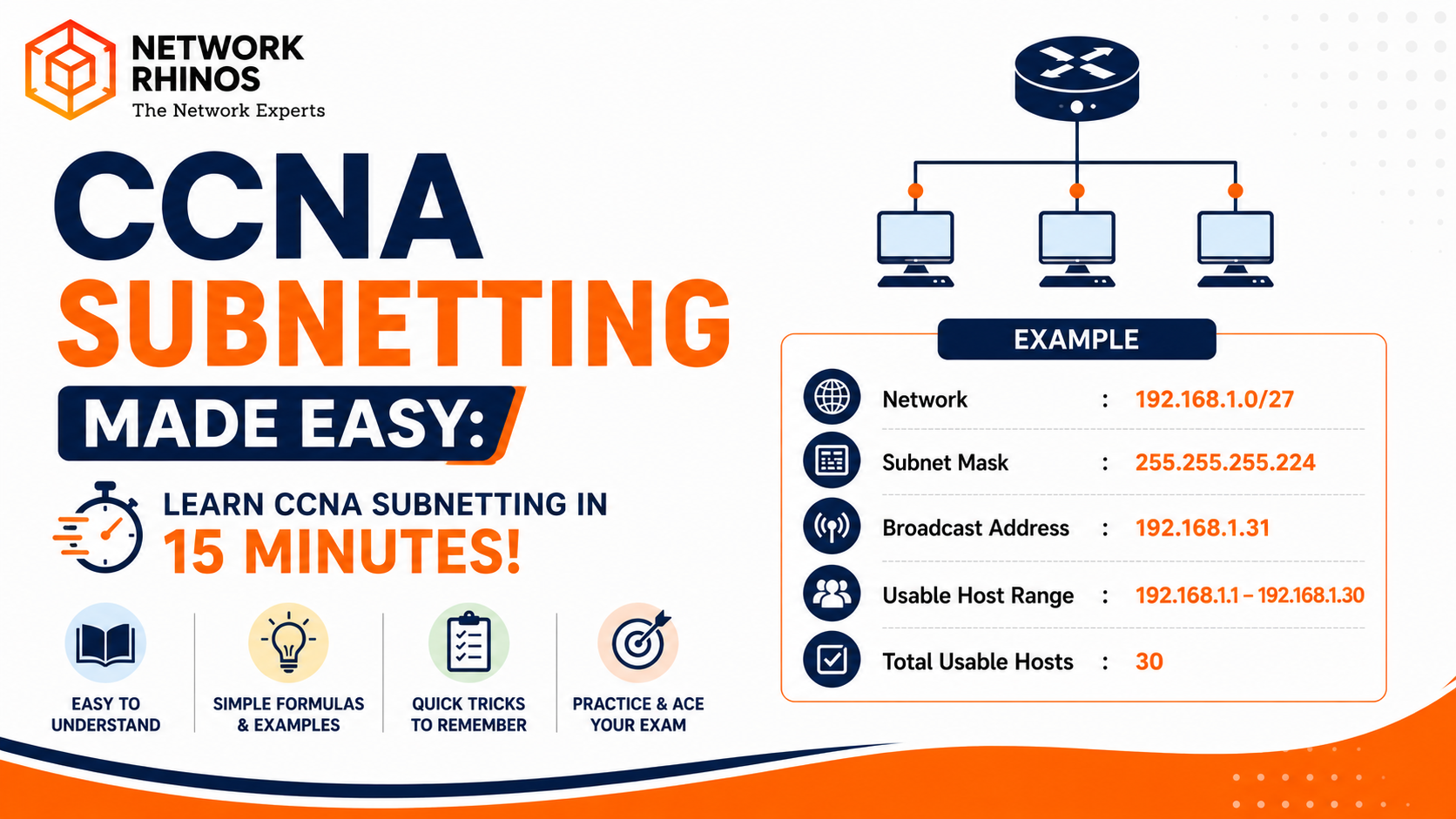
CCNA Subnetting Made Easy: Learn CCNA Subnetting in 15 Minutes
Subnetting is one of the most important topics in the CCNA certification. While many beginners find it confusing, the truth is that CCNA Subnetting becomes simple once you understand a few basic concepts.
Whether you’re preparing for the CCNA 200-301 exam, attending networking interviews, or building a strong networking foundation, learning subnetting is essential.
In this guide, we’ll explain subnetting in simple language with examples so that you can understand the basics in just 15 minutes.
What is CCNA Subnetting?
CCNA Subnetting is the process of dividing a large IP network into multiple smaller networks called subnets.
Instead of using one large network for every device, subnetting helps organize devices into smaller groups.
For example:
Imagine a company with 500 computers.
Instead of placing all 500 devices on one network, they can create multiple smaller networks for:
- HR Department
- Finance Department
- Sales Team
- IT Department
Each department gets its own subnet.
This improves:
- Network performance
- Security
- Broadcast control
- Easier troubleshooting
Why is Subnetting Important?
Subnetting is used in almost every enterprise network.
Benefits include:
- Reduces network congestion
- Improves security
- Efficient utilization of IP addresses
- Better network management
- Smaller broadcast domains
- Faster communication
Without subnetting, networks become slow and difficult to manage.
Understanding an IPv4 Address
An IPv4 address consists of 32 bits divided into four octets.
Example:
192.168.10.25Each octet contains 8 bits.
192 | 168 | 10 | 25The IP address has two parts:
- Network Portion
- Host Portion
The subnet mask tells us where the network ends and the host begins.
What is a Subnet Mask?
A subnet mask identifies which part of an IP address belongs to the network.
Example:
IP Address:
192.168.10.25

Subnet Mask:
255.255.255.0
This is also written as:
/24Meaning:
- First 24 bits → Network
- Remaining 8 bits → Hosts
CIDR Notation Explained
CIDR (Classless Inter-Domain Routing) is a shorter way of writing subnet masks.
| CIDR | Subnet Mask | Hosts |
|---|---|---|
| /24 | 255.255.255.0 | 254 |
| /25 | 255.255.255.128 | 126 |
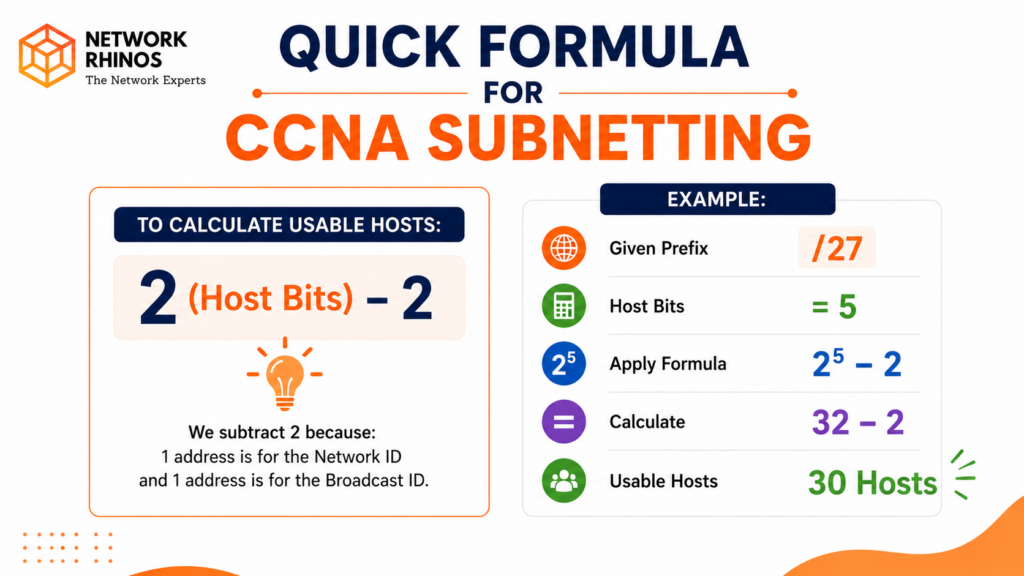
| /26 | 255.255.255.192 | 62 |
| /27 | 255.255.255.224 | 30 |
| /28 | 255.255.255.240 | 14 |
| /29 | 255.255.255.248 | 6 |
| /30 | 255.255.255.252 | 2 |
This table is worth memorizing for the CCNA exam.
Easy Trick to Remember Subnet Sizes
| CIDR | Block Size |
|---|---|
| /24 | 256 |
| /25 | 128 |
| /26 | 64 |
| /27 | 32 |
| /28 | 16 |
| /29 | 8 |
| /30 | 4 |
Most CCNA subnetting questions revolve around this table.
Common CCNA Subnetting Mistakes
Many beginners make these mistakes:
- Forgetting to subtract 2 from the host calculation
- Confusing the network address with the first usable IP
- Incorrect block size calculation
- Ignoring CIDR notation
- Not identifying the broadcast address correctly
Avoid these mistakes by practicing regularly.
Practice Question
Question:
Find the following for:
172.16.10.140/27Determine:
- Network Address
- Broadcast Address
- First Host
- Last Host
Answer
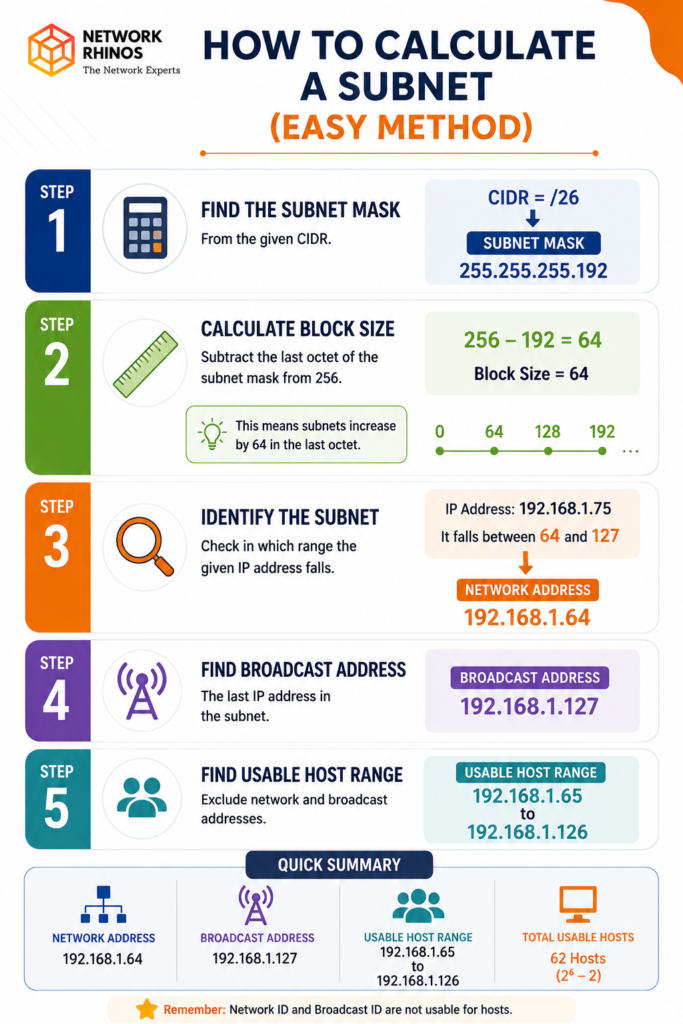
Subnet Mask:
255.255.255.224Block Size:
32Subnets:
0
32
64
96
128
160
140 falls between
128–159Therefore:
Network Address
172.16.10.128Broadcast Address
172.16.10.159Usable Hosts
172.16.10.129

to

172.16.10.158
Tips to Master CCNA Subnetting
- Practice subnetting every day.
- Memorize common subnet masks and CIDR values.
- Learn block size calculations.
- Solve at least 20 subnetting questions daily.
- Use Cisco Packet Tracer to practice real networking scenarios.
- Focus on understanding rather than memorizing formulas.
With consistent practice, subnetting becomes second nature.
Why Learn CCNA Subnetting Before the CCNA Exam?
Subnetting is not just an exam topic—it is a practical networking skill used by network administrators, system engineers, cloud professionals, and cybersecurity experts. Whether you’re configuring routers, creating VLANs, or designing enterprise networks, subnetting plays a key role in efficient IP address management.
A strong understanding of CCNA Subnetting also makes advanced networking topics like routing, switching, ACLs, NAT, and VLAN configuration much easier to learn.
Learn CCNA with Network Rhinos
At Network Rhinos, we believe networking is best learned through practical experience. Our CCNA training combines classroom sessions with extensive lab practice using real-world networking scenarios.
Our CCNA course includes:
- Hands-on subnetting exercises
- Cisco Packet Tracer labs
- Router and switch configuration
- VLANs and Routing
- IPv4 and IPv6 addressing
- Interview preparation
- Mock tests based on the CCNA 200-301 syllabus
- Placement assistance
Whether you’re a student, fresher, or working professional, our expert trainers help you build the practical skills needed for certification and a successful networking career.
Conclusion
Learning CCNA Subnetting doesn’t have to be difficult. Once you understand IP addresses, subnet masks, CIDR notation, and block size calculations, solving subnetting questions becomes much easier.
Keep practicing with different subnet sizes, solve real-world examples, and apply what you learn using networking simulators like Cisco Packet Tracer. With consistent effort, you’ll be well-prepared for the CCNA 200-301 certification exam and ready to tackle real networking challenges with confidence.
Frequently Asked Questions
1. Is subnetting difficult for CCNA beginners?
No. Once you understand subnet masks, CIDR notation, and block sizes, subnetting becomes much easier with regular practice.
2. How long does it take to learn CCNA Subnetting?
Most beginners can grasp the fundamentals in about 15–30 minutes, but mastering subnetting requires daily practice.
3. Is subnetting important for the CCNA 200-301 exam?
Yes. Subnetting is one of the most frequently tested topics and is essential for understanding routing, switching, and IP addressing.
4. Which tool is best for practicing subnetting?
Cisco Packet Tracer is one of the best free tools for practicing subnetting and other CCNA networking concepts.
5. Can I learn CCNA Subnetting without prior networking knowledge?
Absolutely. This topic is beginner-friendly and can be learned step by step with the right guidance and hands-on practice.