What is AWS? A Complete Beginner’s Guide (2026)
Cloud computing has transformed the way businesses build, deploy, and manage applications. Instead of investing in expensive physical servers and infrastructure, organizations can now access computing resources over the internet whenever they need them. One of the leading cloud platforms powering this transformation is Amazon Web Services (AWS).
If you’re wondering “What is AWS?”, this guide will explain everything you need to know from the basics of cloud computing to AWS services, benefits, pricing, career opportunities, and how to start learning AWS in 2026.
What is AWS?
Amazon Web Services (AWS) is a cloud computing platform provided by Amazon that offers more than 200 fully featured cloud services. It enables individuals, startups, enterprises, and governments to build, host, and manage applications without maintaining their own physical servers.
Instead of purchasing hardware, AWS allows you to rent computing resources such as:
- Virtual servers
- Cloud storage
- Databases
- Networking services
- Artificial Intelligence (AI) tools
- Machine Learning (ML) services
- Security solutions
- Analytics platforms
AWS follows a pay-as-you-go pricing model, meaning you only pay for the services you use.
What is Cloud Computing?
Before understanding AWS, it’s important to know what cloud computing means.
Cloud computing is the delivery of IT resources including servers, storage, databases, networking, software, and analytics over the internet.
Instead of buying and maintaining expensive hardware, businesses rent these resources from cloud providers like AWS.
Traditional IT Infrastructure
- Buy physical servers
- Maintain data centers
- Handle hardware failures
- Large upfront investment
- Limited scalability
Cloud Computing with AWS
- No physical hardware to purchase
- Instant deployment
- Scale resources in minutes
- High availability
- Pay only for what you use
History of AWS
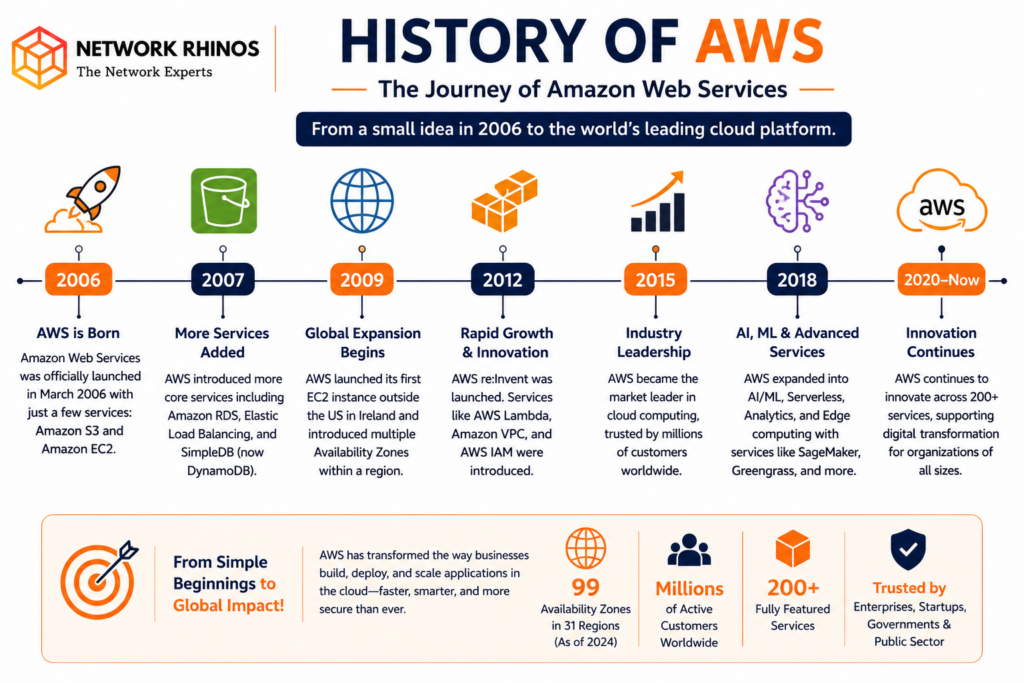
AWS was officially launched by Amazon in 2006 with the goal of making cloud infrastructure available to developers and businesses worldwide.
Initially, AWS offered just a few services, such as:
- Amazon S3
- Amazon EC2
Today, AWS has grown into the world’s largest cloud platform, serving millions of customers across industries including healthcare, finance, education, retail, entertainment, and government.
How Does AWS Work?
AWS operates through a global network of secure data centers.
When you launch a service such as an Amazon EC2 virtual machine, AWS provisions the necessary hardware in one of its data centers and makes it available to you within minutes.
The process is simple:
- Sign in to the AWS Management Console.
- Choose the service you want to use.
- Configure the required settings.
- Launch the resource.
- Pay only for the resources consumed.
This eliminates the need to purchase and maintain physical servers.
AWS Global Infrastructure
AWS has one of the largest cloud infrastructures in the world.
Its infrastructure consists of:
- Regions – Separate geographic locations around the world.
- Availability Zones (AZs) – Isolated data centers within a region for high availability.
- Edge Locations – Global locations used to deliver content quickly through services like Amazon CloudFront.
This global network ensures:
- Low latency
- High availability
- Disaster recovery
- Improved performance
Top AWS Services Every Beginner Should Know
AWS offers hundreds of services, but beginners should focus on the core ones.
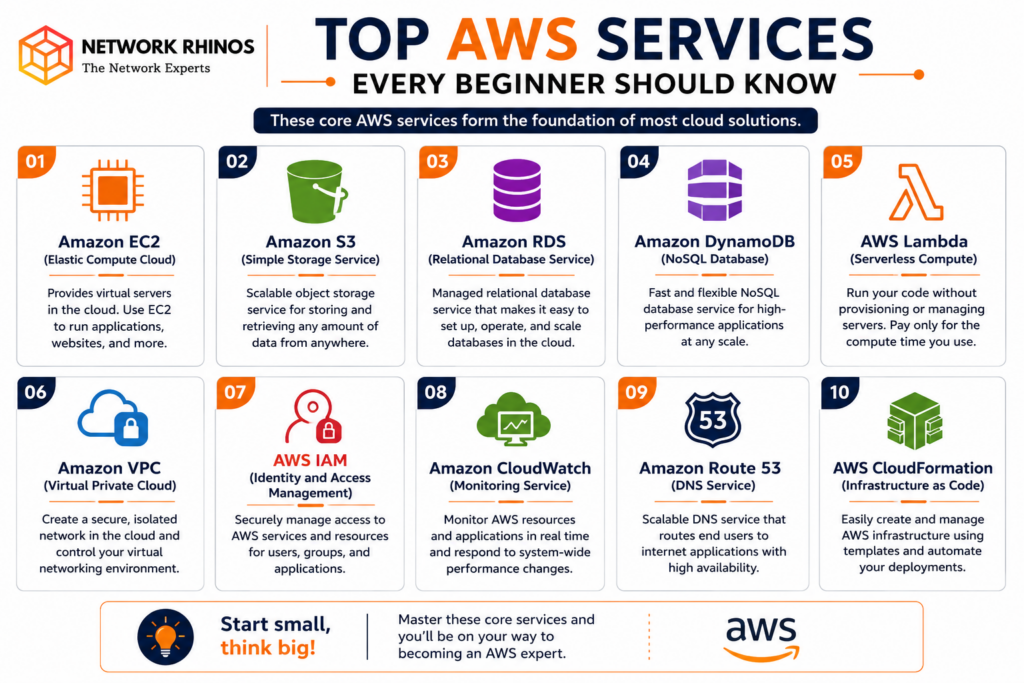
1. Amazon EC2 (Elastic Compute Cloud)
Amazon EC2 provides virtual servers in the cloud.
You can use EC2 to:
- Host websites
- Deploy applications
- Run software
- Create testing environments
2. Amazon S3 (Simple Storage Service)
Amazon S3 is an object storage service designed for storing and retrieving files securely.
Common uses include:
- Website hosting
- File storage
- Image backups
- Video storage
- Application data
3. Amazon RDS (Relational Database Service)
Amazon RDS makes it easy to create and manage relational databases without handling server maintenance.
Supported databases include:
- MySQL
- PostgreSQL
- MariaDB
- SQL Server
- Oracle
4. Amazon DynamoDB
Amazon DynamoDB is a fully managed NoSQL database service designed for applications requiring fast and scalable performance.
It is commonly used for:
- Gaming applications
- E-commerce platforms
- Mobile apps
- Real-time analytics
5. AWS Lambda
AWS Lambda lets you run code without managing servers.
You simply upload your code, and Lambda automatically executes it whenever a predefined event occurs.
This is known as serverless computing.
6. Amazon VPC (Virtual Private Cloud)
Amazon VPC enables you to create a secure and isolated virtual network in AWS.
It provides complete control over:
- IP address ranges
- Subnets
- Route tables
- Security settings
7. AWS IAM (Identity and Access Management)
AWS IAM helps you securely manage access to AWS resources.
You can:
- Create users
- Assign permissions
- Create roles
- Implement least-privilege access
Benefits of Using AWS
AWS has become the preferred cloud platform for businesses because of its flexibility and reliability.
Scalability: Resources can be increased or decreased based on demand.
Cost-Effective: You pay only for the services you consume.
High Availability: AWS provides reliable infrastructure with minimal downtime.
Security: AWS offers advanced security features, including encryption, identity management, and compliance certifications.
Global Reach: Applications can be deployed closer to users across multiple regions worldwide.
Fast Deployment: Infrastructure can be provisioned within minutes instead of weeks.
AWS Pricing Model
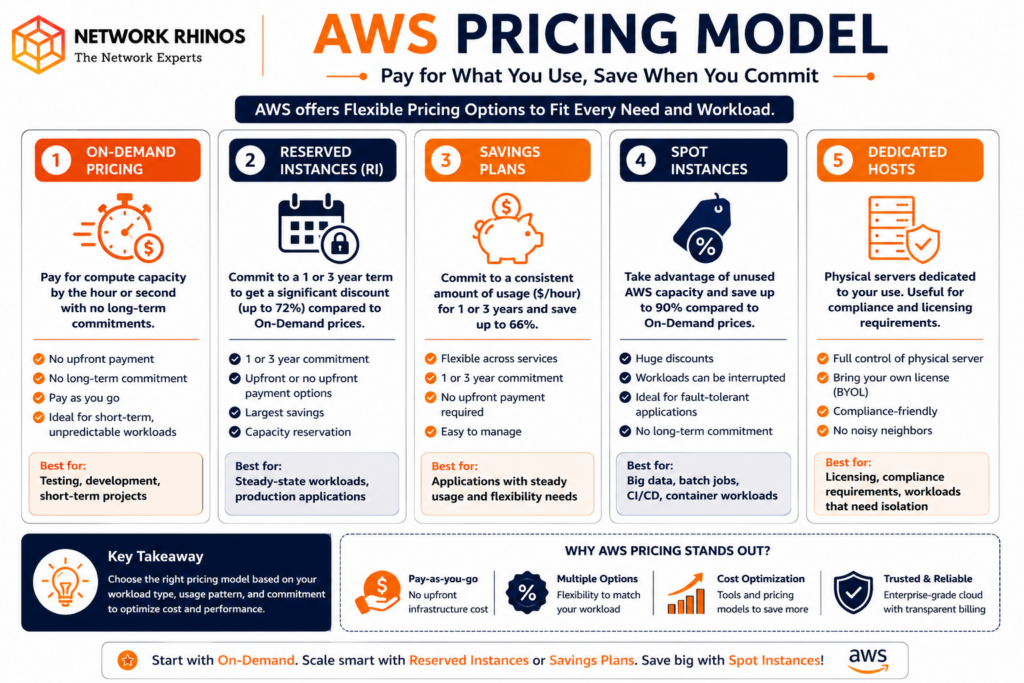
One of AWS’s biggest advantages is its flexible pricing.
Common pricing models include:
- Pay-As-You-Go
- Reserved Instances
- Savings Plans
- Spot Instances
- Free Tier
This allows organizations to optimize costs while scaling efficiently.
Who Uses AWS?
AWS is used by organizations of all sizes, including:
- Startups
- Small businesses
- Large enterprises
- Educational institutions
- Healthcare providers
- Government agencies
- Financial organizations
- Media and entertainment companies
Real-World Use Cases of AWS
AWS powers a wide range of applications and services.
Examples include:
- Hosting websites
- Mobile application backends
- Video streaming platforms
- Online gaming
- Data analytics
- AI and Machine Learning
- Internet of Things (IoT)
- Backup and disaster recovery
- Enterprise applications
- E-commerce platforms
Why Learn AWS in 2026?
Cloud adoption continues to grow rapidly, making AWS one of the most valuable skills in the IT industry.
Learning AWS can open opportunities in roles such as:
- Cloud Engineer
- AWS Solutions Architect
- DevOps Engineer
- Cloud Administrator
- Site Reliability Engineer (SRE)
- Cloud Security Engineer
- Systems Administrator
Professionals with AWS expertise are in demand across industries because organizations are increasingly migrating their infrastructure to the cloud.
How to Start Learning AWS?
If you’re new to AWS, follow this learning path:
- Understand cloud computing fundamentals.
- Create an AWS Free Tier account.
- Learn IAM, EC2, S3, and VPC.
- Practice launching and managing cloud resources.
- Explore databases such as RDS and DynamoDB.
- Learn monitoring with CloudWatch.
- Study AWS networking and security concepts.
- Prepare for the AWS Certified Cloud Practitioner certification.
- Build hands-on projects.
- Continue with advanced AWS certifications.
Consistent hands-on practice is essential to becoming proficient in AWS.
Frequently Asked Questions
Is AWS free?
AWS offers a Free Tier that includes limited usage of many popular services for new users. Charges apply if you exceed the free usage limits or use services not covered by the Free Tier.
Is AWS difficult to learn?
No. Beginners can start with fundamental services like EC2, S3, IAM, and RDS before progressing to more advanced topics.
Which AWS certification should beginners choose?
The AWS Certified Cloud Practitioner certification is widely recommended as the starting point for beginners.
What programming language is required for AWS?
AWS supports multiple programming languages, including Python, Java, JavaScript, C#, Go, and others. While programming knowledge is helpful, many AWS services can be used through the AWS Management Console without writing code.
Conclusion
AWS has become the leading cloud computing platform by offering scalable, secure, and cost-effective services that help businesses innovate faster. Whether you want to host applications, store data, build serverless solutions, or start a career in cloud computing, AWS provides the tools and infrastructure to achieve those goals.
For beginners, the best approach is to learn the fundamentals, gain hands-on experience with core services such as Amazon EC2, Amazon S3, Amazon RDS, AWS Lambda, and AWS IAM, and gradually progress to advanced topics. With cloud skills in high demand, learning AWS in 2026 is a valuable investment for anyone looking to build a successful IT career.
Ready to Start Your AWS Journey?
Looking for practical, instructor-led AWS training? Network Rhinos offers hands-on cloud training designed for beginners and working professionals, covering AWS fundamentals, real-world labs, certification preparation, and industry-focused projects to help you build confidence and job-ready skills.