AWS Training in Chennai: Fees, Duration, Certification, Syllabus & Career Guide
Cloud computing has become an important part of the IT industry, and AWS is one of the major cloud platforms used by organizations around the world. Because of this, many students, freshers, and working professionals are now looking for the right AWS training in Chennai to build practical cloud skills and improve their career opportunities.
But choosing an AWS course is not always simple. You may find different training institutes, course fees, durations, certification options, online classes, classroom programs, and placement support. So, how do you know which course is right for you?
This guide explains what you should know before joining an AWS course in Chennai, including the syllabus, duration, fees, certifications, practical training, career opportunities, and how to choose a good AWS training institute.
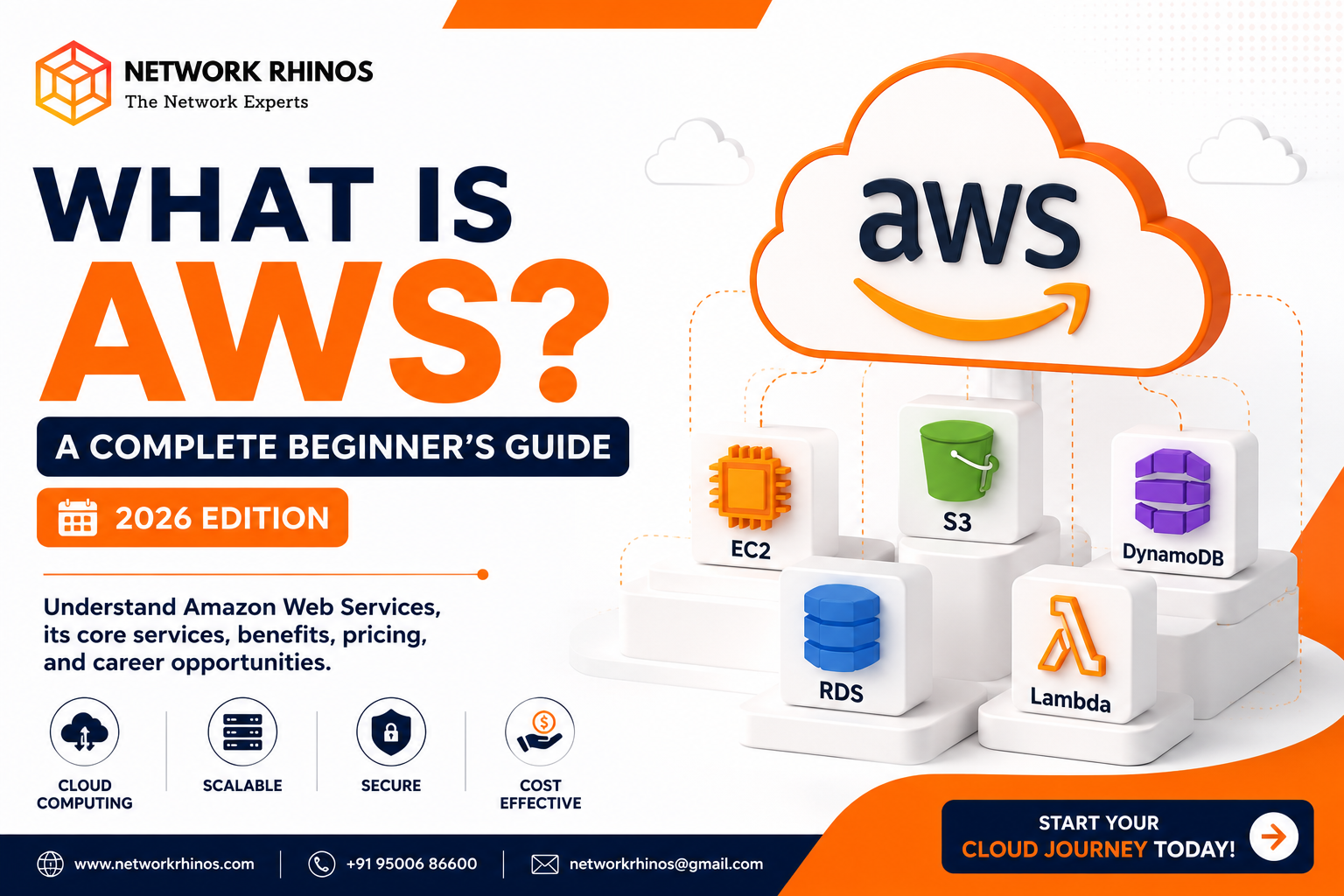
What Is AWS?
AWS stands for Amazon Web Services. It is a cloud computing platform that provides services for computing, storage, databases, networking, security, monitoring, application development, and many other IT requirements.
Instead of purchasing and maintaining physical servers, companies can use cloud services according to their requirements. For example, a company can use Amazon EC2 to run applications, Amazon S3 to store files and data, and Amazon RDS to manage relational databases.
For someone starting a cloud career, learning AWS can provide a strong foundation in modern IT infrastructure and cloud technologies.
Why Learn AWS?
The way companies build and manage IT infrastructure has changed significantly. Cloud platforms allow organizations to deploy applications, store data, scale resources, and manage infrastructure without depending entirely on traditional physical servers.
This has created opportunities in areas such as:
- Cloud computing
- Cloud administration
- Cloud support
- Cloud architecture
- DevOps
- Infrastructure management
- Cloud security
- Application deployment
However, simply watching videos about AWS is usually not enough to become job-ready. Students need to understand how different AWS services work together and, more importantly, get opportunities to practice them.
That is why choosing practical AWS training in Chennai can be useful for students who want structured learning.
Who Should Join AWS Training in Chennai?
An AWS course is not only for experienced IT professionals. The right learning path can be useful for different types of learners.
1. Freshers
Fresh graduates who want to enter cloud computing can start with AWS fundamentals and gradually move toward practical services and projects.
2. IT Professionals
System administrators, network engineers, software developers, technical support professionals, and other IT employees can learn AWS to expand their existing skills.
3. Students
Students who are interested in cloud computing can use AWS training to understand technologies that are widely used in modern IT environments.
4. Career Switchers
Professionals from other technical backgrounds may choose AWS as part of a transition toward cloud and infrastructure-related roles.
If you are completely new to cloud computing, starting with fundamentals is important. AWS itself positions Cloud Practitioner as a foundational certification for people who want a high-level understanding of AWS Cloud, including candidates without previous IT or cloud experience.
AWS Course in Chennai: What Will You Learn?
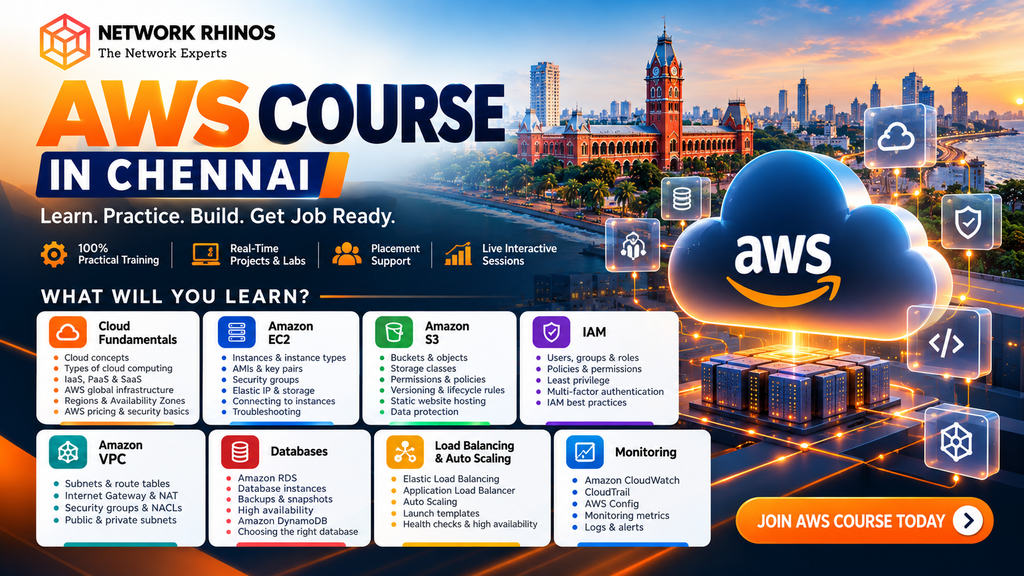
A good AWS course should go beyond definitions and presentations. Students should understand the purpose of AWS services and how they are used in real environments.
Depending on the training program, an AWS syllabus may include:
AWS Cloud Fundamentals
You can start by understanding:
- What cloud computing means
- Types of cloud computing
- Public, private, and hybrid cloud concepts
- IaaS, PaaS, and SaaS
- AWS global infrastructure
- Regions and Availability Zones
- AWS shared responsibility model
- Cloud security basics
- AWS pricing concepts
Amazon EC2
Amazon EC2 allows users to run virtual servers in the AWS Cloud.
Students can learn about:
- EC2 instances
- Instance types
- AMIs
- Key pairs
- Security groups
- Elastic IP
- Instance storage
- Connecting to instances
- Basic EC2 troubleshooting
Amazon S3
Amazon S3 is used for object storage.
Training may cover:
- Buckets
- Objects
- Storage classes
- Bucket policies
- Permissions
- Versioning
- Lifecycle rules
- Static website hosting
- Data protection
IAM
AWS Identity and Access Management is an important part of AWS security.
Students should understand:
- Users
- Groups
- Roles
- Policies
- Permissions
- Least privilege
- Multi-factor authentication
Amazon VPC
Networking knowledge is extremely useful when working with AWS.
A practical AWS training program should introduce:
- VPC
- Subnets
- Route tables
- Internet Gateway
- NAT Gateway
- Security groups
- Network ACLs
- Public and private subnets
Databases
AWS provides several database options.
Depending on the course, students may learn about:
- Amazon RDS
- Database instances
- Automated backups
- Snapshots
- Availability
- Amazon DynamoDB
- Choosing the right database service
Load Balancing and Auto Scaling
Students can learn how applications can be designed to handle changing workloads.
Topics may include:
- Elastic Load Balancing
- Application Load Balancer
- Auto Scaling
- Launch templates
- Health checks
- High availability
Monitoring
AWS environments also need monitoring and management.
Training can include services such as:
- Amazon CloudWatch
- CloudTrail
- AWS Config
- Monitoring metrics
- Logs
- Alerts
The exact syllabus can vary from one AWS training institute in Chennai to another, so students should always ask for the detailed curriculum before enrolling.
AWS Course Fees in Chennai
One of the most common questions students ask is:
“How much does an AWS course cost in Chennai?”
There is no single fixed price for every AWS course. AWS course fees in Chennai can vary depending on the training provider, course level, duration, delivery mode, lab access, projects, certification preparation, and additional career support.
Before choosing the cheapest course, compare what you are actually getting.
For example, ask:
- Is practical lab access included?
- Are real-world projects included?
- Is certification preparation provided?
- Are mock interviews included?
- Is there doubt-clearing support?
- Are classroom and online options available?
- Does the course cover current AWS services?
- Is career guidance provided?
A low-cost course may look attractive initially, but the cheapest option is not necessarily the best option if it provides only theory.
The better question is:
What skills will I have after completing the course?
AWS Course Duration in Chennai
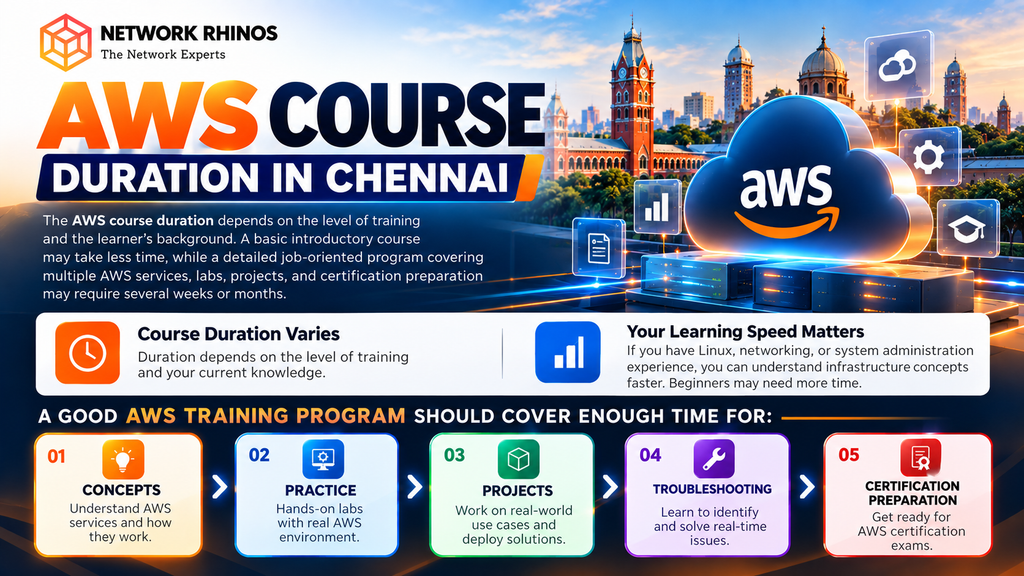
The AWS course duration depends on the level of training and the learner’s background.
A basic introductory course may take less time, while a detailed job-oriented program covering multiple AWS services, labs, projects, and certification preparation may require several weeks or months.
Your learning speed also matters.
Someone with Linux, networking, or system administration experience may understand infrastructure concepts faster than someone completely new to IT.
Therefore, don’t select an AWS course only because it has a short duration. A better AWS training program should provide enough time for:
Concepts → Practice → Projects → Troubleshooting → Certification Preparation
AWS Certification: Which One Should You Choose?
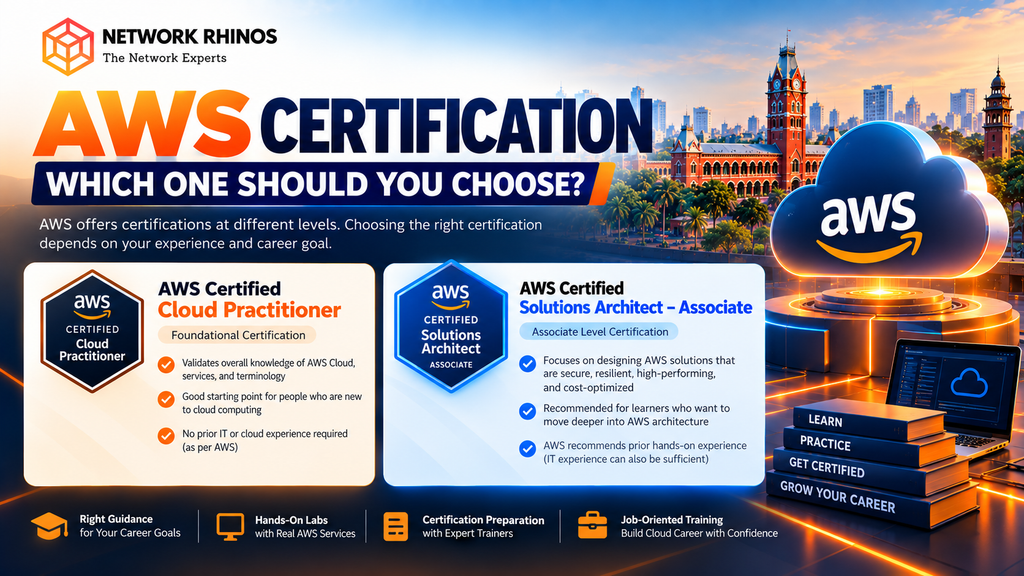
AWS offers certifications at different levels. Choosing the right certification depends on your experience and career goal.
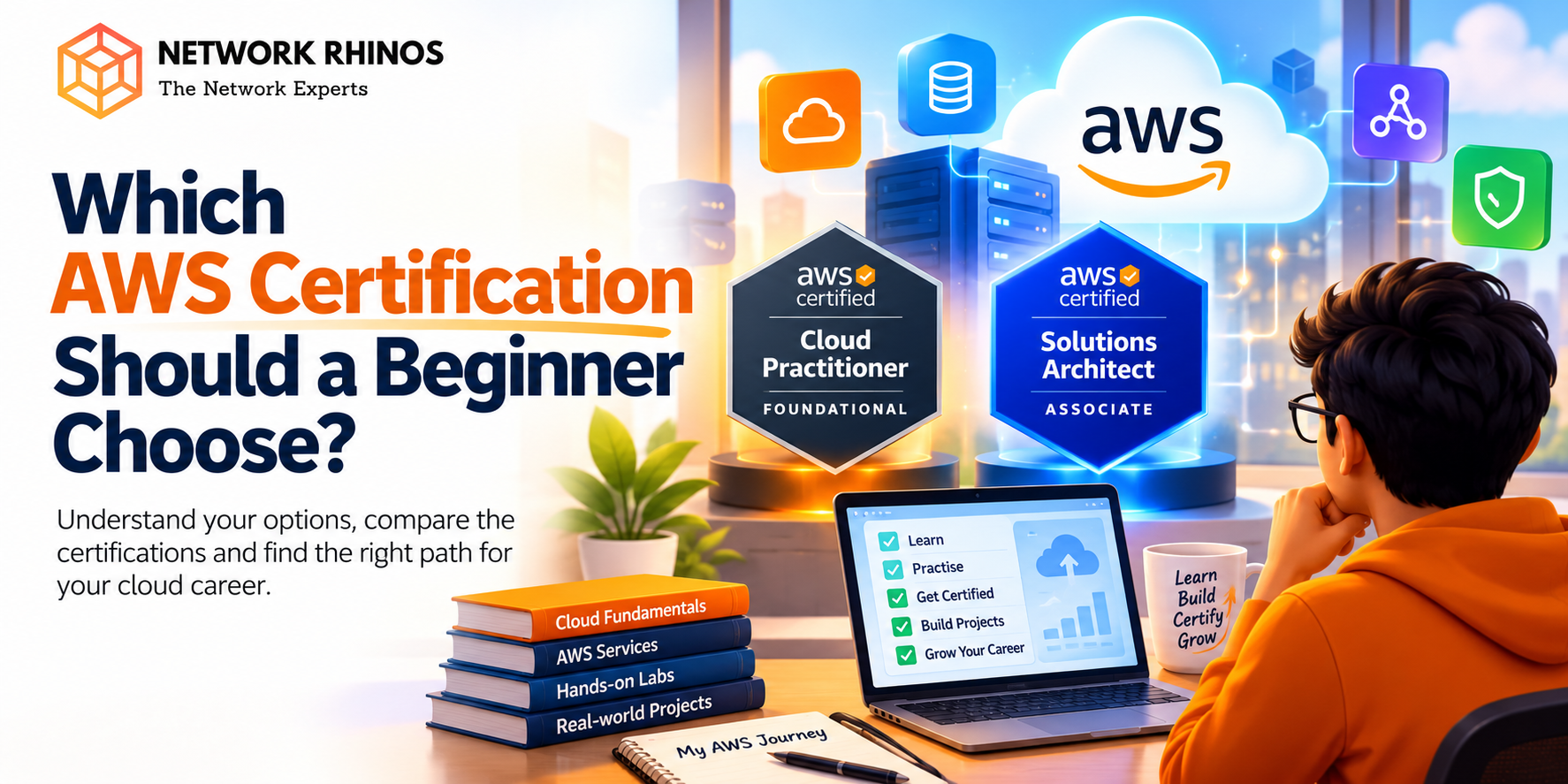
AWS Certified Cloud Practitioner
Cloud Practitioner is a foundational certification designed to validate overall knowledge of AWS Cloud, services, and terminology.
It can be a good starting point for people who are new to cloud computing. AWS specifically states that previous IT or cloud experience is not required for this certification.
AWS Certified Solutions Architect – Associate
For learners who want to move deeper into AWS architecture, the AWS Certified Solutions Architect Associate is an important certification to consider.
It focuses on designing AWS solutions that are secure, resilient, high-performing, and cost-optimized.
AWS recommends prior hands-on experience for this certification, although people with IT experience can also use it as part of their AWS learning journey.
Other AWS Certification Paths
Depending on your career direction, you can later explore certifications related to development, operations, data, machine learning, security, and professional-level architecture.
AWS currently organizes certifications into foundational, associate, professional, and specialty levels.
The important point is that AWS certification and AWS training are not the same thing.
Training helps you build knowledge and practical skills. The certification exam validates specific knowledge and skills against AWS’s exam objectives.
Is AWS Training Suitable for Freshers?
Yes, but freshers should have realistic expectations.
Completing an AWS course does not automatically make someone an experienced cloud engineer. Students need to build practical knowledge and understand the fundamentals behind the services they are using.
A fresher can start with:
Cloud Fundamentals → Linux Basics → Networking Basics → AWS Core Services → Hands-on Labs → Projects → Certification → Interview Preparation
This approach is much more useful than trying to memorize AWS service definitions.
If you are a fresher, look for an AWS training for beginners program that explains concepts from the ground up.
AWS Training with Placement: What Should Students Check?
Many students search for AWS training in Chennai with placement because they want career support after completing their course.
However, students should understand what “placement assistance” actually means before joining.
Ask the institute:
- Does it provide interview preparation?
- Are mock interviews conducted?
- Is resume preparation included?
- Are interview questions discussed?
- Are job opportunities shared?
- Is there career guidance?
- Does the training include practical projects?
- Is there support after course completion?
Placement assistance should complement technical training. It cannot replace the need for students to develop their own skills.
Why Hands-On AWS Training Matters?
Cloud computing is practical.
You can read about an EC2 instance for hours, but creating one, connecting to it, configuring security groups, installing software, monitoring it, and troubleshooting a problem gives you a completely different level of understanding.
That is why AWS practical training should be an important factor when choosing an institute.
A good lab environment can allow students to practice:
- Creating AWS resources
- Configuring IAM
- Building VPC networks
- Launching EC2 instances
- Working with S3
- Configuring databases
- Setting up load balancing
- Monitoring resources
- Troubleshooting common problems
Practical experience also gives students better examples to discuss during interviews.
AWS Real-Time Projects
Projects can help connect theory with practical work.
For example, a training program could include projects involving:
Project 1: Deploying a Website on AWS
Students can learn how to host a website using AWS services and configure access and security.
Project 2: Building a Basic VPC
Students can create a VPC with public and private subnets and understand how routing works.
Project 3: Highly Available Application
Students can explore load balancing and Auto Scaling to understand how applications can handle changing traffic.
Project 4: Secure Cloud Environment
Students can work with IAM permissions, security groups, network controls, and monitoring.
The exact projects will vary, but the goal should always be the same: learn by doing.
AWS Classroom Training vs Online Training
Students often search for both AWS classroom and online training in Chennai.
Both options can work well.
Classroom Training
Classroom learning can be useful if you:
- Prefer face-to-face interaction
- Learn better through direct explanations
- Want to ask questions immediately
- Prefer a structured schedule
- Want to interact with other students
Online Training
Online learning can be useful if you:
- Have a busy schedule
- Live far from the training center
- Prefer flexible learning
- Want to attend from home
- Need access to recorded sessions
The most important factor is not simply classroom versus online.
It is the quality of instruction, practical exposure, learning support, and consistency of your own practice.
How to Choose the Best AWS Training Institute in Chennai
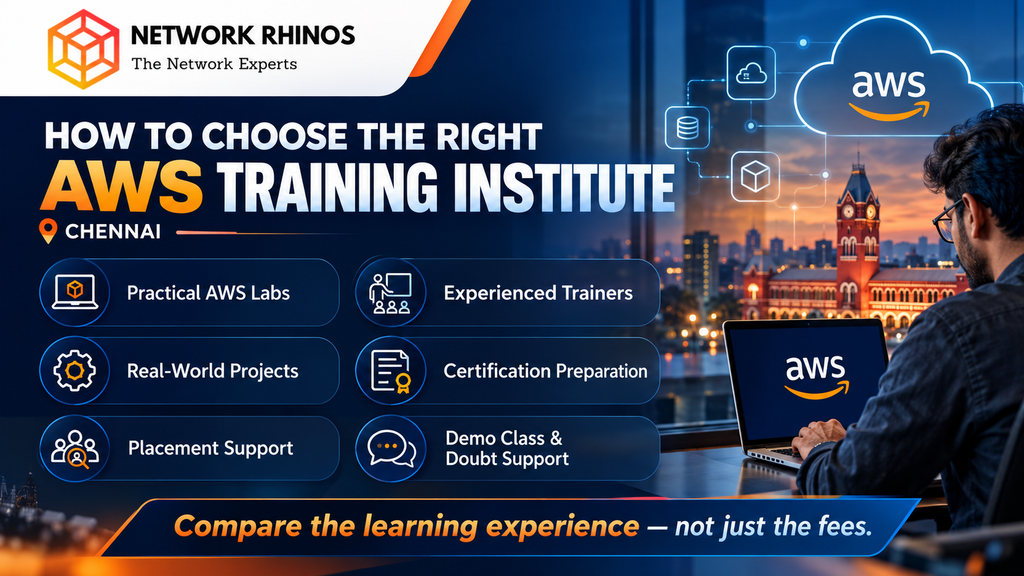
Searching for the best AWS training institute in Chennai can produce many options.
Instead of choosing based only on advertisements or discounts, compare institutes using the following checklist.
1. Check the AWS Syllabus
Make sure the curriculum covers the services and concepts you actually want to learn.
2. Ask About Practical Labs
Find out whether students get hands-on access to AWS environments.
3. Check Trainer Experience
A trainer should be able to explain not only what a service does, but also why and when it should be used.
4. Look for Projects
Projects help students apply their knowledge.
5. Ask About Certification Preparation
If certification is your goal, ask whether the course follows the relevant AWS exam objectives.
6. Understand Placement Assistance
Ask exactly what career support is provided.
7. Compare Course Duration
Avoid choosing a course simply because it promises to finish everything very quickly.
8. Attend a Demo Class
A demo can help you understand the trainer’s teaching style before making a decision.
9. Check Learning Support
Ask whether students can get help with doubts, assignments, labs, and projects.
10. Compare the Overall Value
Compare the entire package instead of comparing only AWS training fees.
AWS Training Near Me: What Should You Look For?
If you search Google for AWS training near me, you will probably see several training centers.
Location is useful, especially if you prefer classroom learning. Chennai has training options across areas such as Velachery, Anna Nagar, Vadapalani, OMR and other IT-focused locations.
However, don’t choose an institute only because it is close to your home.
A nearby course with weak practical training may not be as valuable as a slightly farther institute with a strong curriculum, experienced trainers, labs, and career support.
Choose based on learning quality first and convenience second.
What Jobs Can You Get After AWS Training?
AWS skills can be useful for several technology roles.
Depending on your existing skills and experience, possible career paths include:
- Cloud Support Engineer
- AWS Cloud Engineer
- Cloud Administrator
- Cloud Operations Engineer
- Solutions Architect
- DevOps Engineer
- Infrastructure Engineer
- Cloud Consultant
However, AWS alone is not a guarantee of a particular job or salary.
Employers may also look for knowledge of Linux, networking, scripting, databases, security, DevOps tools, and problem-solving.
That is why students should think beyond certification.
Build skills, not just certificates.
AWS Career Path for Beginners
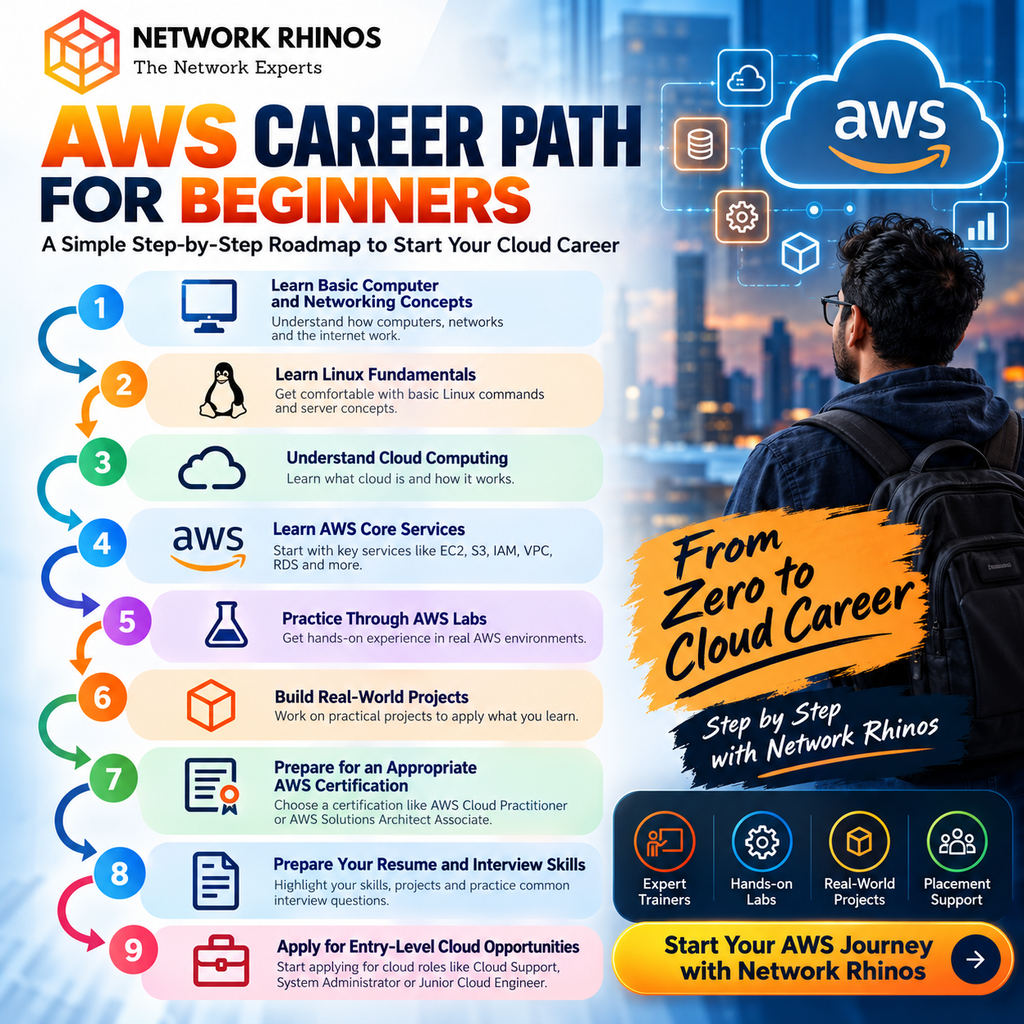
If you are starting from zero, you don’t have to learn everything at once.
A simple roadmap can look like this:
Step 1: Learn basic computer and networking concepts
↓
Step 2: Learn Linux fundamentals
↓
Step 3: Understand cloud computing
↓
Step 4: Learn AWS core services
↓
Step 5: Practice through AWS labs
↓
Step 6: Build real-world projects
↓
Step 7: Prepare for an appropriate AWS certification
↓
Step 8: Prepare your resume and interview skills
↓
Step 9: Apply for entry-level cloud opportunities
This gives beginners a clear direction instead of trying to learn dozens of AWS services randomly.
Is AWS Certification Worth It?
For the right learner, AWS certification can be valuable because it provides a recognized way to demonstrate AWS knowledge.
But certification should not be treated as a replacement for practical experience.
For example, someone who has memorized practice questions but cannot explain a VPC, IAM role, EC2 security group, or basic cloud architecture may struggle in a technical interview.
On the other hand, someone who understands the concepts, has completed projects, and uses certification as additional validation can present a much stronger profile.
AWS itself recommends combining exam preparation with learning resources and practical activities such as AWS Builder Labs and other hands-on preparation options.
Frequently Asked Questions About AWS Training in Chennai
Is AWS training suitable for beginners?
Yes. Beginners can start with cloud fundamentals and gradually move into AWS services. Cloud Practitioner is specifically positioned by AWS as a foundational starting point for people new to cloud.
What is the AWS course fee in Chennai?
AWS course fees vary depending on the institute, duration, delivery mode, lab access, projects, certification preparation, and career support. Compare the complete course value rather than choosing only based on price.
How long does AWS training take?
The duration depends on the course level, syllabus, learning schedule, and practical training included. A complete job-oriented program generally needs enough time for theory, labs, projects, and interview preparation.
Can freshers learn AWS?
Yes. Freshers can learn AWS by starting with the fundamentals and gradually building practical skills. Basic Linux and networking knowledge can also be helpful.
Which AWS certification is best for beginners?
AWS Certified Cloud Practitioner is a foundational option for people who are new to cloud. Learners who want to move into deeper technical architecture can consider Solutions Architect – Associate after developing the required knowledge and practical understanding.
Is classroom AWS training better than online training?
Neither is automatically better. Choose the format that matches your learning style. The quality of the trainer, practical labs, curriculum, projects, and learning support matters more than the format alone.
Does AWS certification guarantee a job?
No certification can guarantee a job. Certification can strengthen your profile, but practical skills, projects, communication, problem-solving ability, and interview performance are also important.
Should I choose AWS training with placement assistance?
It can be useful, especially for freshers. However, check what the institute actually means by placement assistance and whether it includes resume support, mock interviews, career guidance, and job opportunities.
Final Thoughts
Choosing the right AWS training in Chennai is an important decision, especially if your goal is to build a career in cloud computing.
Don’t choose a course simply because it has a low fee or a short duration. Instead, look at the complete learning experience.
A good AWS course in Chennai should help you understand cloud fundamentals, learn important AWS services, practice through hands-on labs, work on projects, prepare for relevant certification exams, and improve your interview readiness.
If you are a beginner, start with the fundamentals. If you already have IT experience, you can move faster into technical AWS services and architecture. Most importantly, keep practicing.
AWS is a large platform, so you don’t need to master everything on day one.
Start with the basics, build your knowledge step by step, practice what you learn, and gradually work toward the AWS certification and career path that matches your goals.
For students and professionals searching for AWS training in Chennai, the right course should ultimately give you something more valuable than a certificate: the confidence and practical skills to work with cloud technology.