
CCNP vs CCNA: What Changes When You Move to Professional-Level Networking?
If you have completed CCNA and are thinking about what to learn next, you have probably come across CCNP certification.
At first, CCNP can look like simply the next level after CCNA. But the difference is not just about learning more commands or studying a bigger syllabus. The real change happens in how you approach networking.
With CCNA, you build the foundation. You learn how networks work, how devices communicate, how routing and switching happen, and how to troubleshoot common problems.
With CCNP, you start looking at networks from a more professional and enterprise-level perspective. You deal with larger environments, advanced routing, troubleshooting, network design, automation, and technologies used in modern enterprise networks.
So, what actually changes when you move from CCNA to CCNP?
Let’s break it down.
CCNA vs CCNP: The Basic Difference
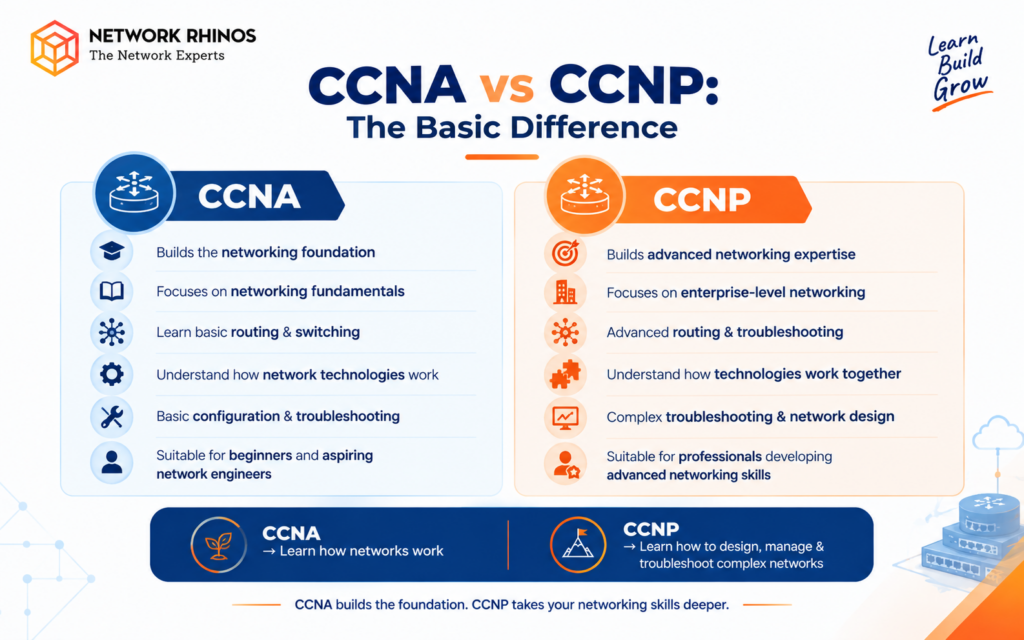
The easiest way to understand the difference is to think about the type of questions you are trying to answer.
At the CCNA level, you may ask:
- How does a switch forward a frame?
- What is an IP address?
- How does OSPF work?
- What is a VLAN?
- How does a router choose a path?
- How do I configure a basic network?
At the CCNP level, the questions become more practical and complex:
- Why are these OSPF neighbors not forming?
- Why is a particular route being preferred?
- How should routing be designed across multiple locations?
- What happens when a redundant path fails?
- How can a large network be monitored and troubleshot?
- Where can automation reduce repetitive configuration work?
- How should different technologies work together in an enterprise environment?
That is one of the biggest changes between CCNA and CCNP. CCNA helps you understand networking. CCNP pushes you toward solving real networking problems.
1. The Scope of Networking Becomes Wider
CCNA gives you a strong foundation in networking concepts.
You learn about IP addressing, subnetting, routing, switching, VLANs, wireless concepts, security fundamentals, automation basics and other core networking areas. When you move to CCNP Enterprise, the scope becomes much broader.
You begin dealing with topics such as:
- Advanced routing
- Enterprise network architecture
- Network assurance
- Infrastructure services
- Security concepts
- Virtualization
- Network automation
- Software-defined networking
- Advanced troubleshooting
The goal is not simply to remember what each technology does.
You need to understand why it is being used, how it interacts with other technologies, and what can go wrong.
That difference becomes very noticeable when you start working on practical labs.
2. Troubleshooting Becomes a Much Bigger Part of Your Learning
One of the biggest differences between CCNA and CCNP is troubleshooting. At the beginner level, you might troubleshoot a simple problem such as: “The PC cannot communicate with the gateway.” At the professional level, the problem might look very different.
For example: “Users in one branch can reach the data centre, but traffic from the data centre cannot return to the branch. Now you need to investigate multiple possibilities.
Is it:
- Routing?
- Route filtering?
- Redistribution?
- An incorrect next hop?
- An interface problem?
- An access-control issue?
- A routing protocol problem?
- A configuration inconsistency?
This is where CCNP-level learning becomes more interesting.
Instead of immediately changing configurations, you learn to identify the problem first, collect information, understand the traffic path and then make the appropriate change.
That troubleshooting mindset is useful far beyond the certification exam.
3. Routing Gets More Advanced
Routing is an important part of both CCNA and CCNP, but the depth changes considerably. With CCNA, you learn the fundamentals of routing and protocols such as OSPF. With CCNP, routing becomes more detailed.
You may work with:
- Advanced OSPF concepts
- BGP
- Route redistribution
- Policy-based routing
- Routing protocols in larger environments
- VPN technologies
- IPv4 and IPv6
- Advanced routing troubleshooting
The important part is not simply learning more routing commands. You need to understand how routing decisions are made. For example, if two routes exist for the same destination, why is one selected? If routes are being exchanged between different routing protocols, what happens? If a route disappears, how does the network respond? These are the kinds of questions that help you move from basic configuration toward professional network engineering.
4. You Start Thinking About the Network as a Whole
A CCNA learner often focuses on individual devices.
A CCNP learner needs to start thinking about the entire network.
Imagine an organization with:
- Multiple branch offices
- Data centres
- Internet connections
- Redundant routers
- Multiple switches
- Wireless networks
- Security devices
- Cloud connectivity
Changing one configuration may affect several parts of the network.
So you need to think about things such as:
- Availability: What happens if a device or link fails?
- Scalability: Will the design continue to work when the organization grows?
- Performance: Can the network handle the expected traffic?
- Security: How can access and communication be controlled?
- Manageability: Can engineers monitor and troubleshoot the environment efficiently?
This broader way of thinking is an important part of moving toward professional-level networking.
5. CCNP Is Not Just About Learning More Commands
This is a common misconception. Someone moving from CCNA to CCNP may think:
“I just need to learn more Cisco commands.”
Commands are certainly important, but they are not the main point. Imagine you are given a network problem. Knowing 50 commands does not automatically tell you which command you should use.
A good network engineer first asks:
- What exactly is the problem?
- Where is the problem occurring?
- What information do I need?
- What does the current configuration tell me?
- What is the expected behaviour?
- What is actually happening?
- What change can solve the problem without creating another issue?
That approach is much more valuable than simply memorising commands.
6. Automation Becomes More Relevant
Modern networking is not limited to manually configuring every device. As networks become larger, automation becomes increasingly useful.
At the CCNP level, you are introduced to concepts involving:
- Python
- APIs
- Controllers
- Network automation tools
- Programmability
- Automated configuration and management
You do not necessarily need to become a full-time software developer. However, understanding basic programming and automation can help network engineers work more efficiently. For example, instead of manually checking hundreds of devices, automation can help collect information from multiple devices and present it in a usable format. This is one reason CCNP certification preparation can be useful for network engineers who want to understand where traditional networking is heading.
7. Modern Enterprise Networking Becomes Part of the Picture
Enterprise networks have changed significantly.
Organizations may now have a combination of:
- Traditional data centres
- Branch offices
- Cloud platforms
- Remote users
- SD-WAN
- Virtualized infrastructure
- Security solutions
- Automated network management
Because of this, professional network engineers need to understand how different technologies fit together. CCNP Enterprise learning introduces you to these broader enterprise networking concepts. The objective is not to learn every technology in the IT industry. It is to understand how networking works inside a modern enterprise environment.
CCNA vs CCNP: A Simple Comparison
| Area | CCNA | CCNP Enterprise |
|---|---|---|
| Learning level | Foundation | Professional |
| Networking concepts | Core concepts | Advanced concepts |
| Routing | Fundamentals | Advanced routing and troubleshooting |
| Troubleshooting | Basic problems | Complex network problems |
| Network design | Basic understanding | Enterprise-level thinking |
| Automation | Introduction | More advanced exposure |
| Enterprise technologies | Fundamentals | Broader enterprise technologies |
| Practical focus | Configuration and fundamentals | Design, troubleshooting and implementation |
| Main objective | Build networking foundation | Develop professional-level networking skills |
The important thing to remember is that CCNP is not simply “CCNA with more topics.”
The depth of understanding changes.
Do You Need CCNA Before CCNP?
Not necessarily.
You do not have to hold a CCNA certification before starting the CCNP certification path. However, having a strong CCNA-level foundation can make CCNP learning much easier.
Before starting CCNP, you should be comfortable with areas such as:
- IP addressing and subnetting
- VLANs
- Routing fundamentals
- Switching concepts
- OSPF basics
- IPv4 and IPv6 fundamentals
- Network troubleshooting
- Basic security concepts
- Cisco IOS commands
If these concepts are still confusing, jumping directly into advanced topics can make the learning process unnecessarily difficult. So rather than asking only “Do I have a CCNA certificate?”, ask: “Do I have the networking foundation required to understand CCNP topics?” That is a much more useful question.
When Should You Move From CCNA to CCNP?
There is no single timeline that works for everyone.
You may be ready to start CCNP when you can comfortably work with basic networking concepts and are no longer dependent on step-by-step instructions for every configuration.
For example, you should be able to look at a simple network diagram and understand:
- Which devices are connected
- Where routing is taking place
- How traffic should move
- Which protocols are being used
- Where a problem might exist
Practical experience can also help.
You don’t necessarily need years of experience before starting CCNP, but having some hands-on exposure to networking can make the advanced concepts easier to understand.
What Does the CCNP Certification Path Look Like?
For CCNP Enterprise, the certification path involves a core exam along with a concentration exam.
The core portion focuses on enterprise networking concepts, while concentration options allow learners to go deeper into specific areas such as advanced routing, automation, SD-WAN, network assurance and other enterprise technologies. This gives learners some flexibility depending on the direction they want to develop.
For someone interested in advanced routing and troubleshooting, for example, a different concentration may make more sense than someone who wants to explore network automation. So the CCNP certification is not simply one large exam covering everything. It is a structured path that combines broad enterprise networking knowledge with a more focused area of study.
What Changes Most When You Move From CCNA to CCNP?
If we had to simplify the entire difference, it would come down to this:
With CCNA, you learn:
“How does this technology work?”
With CCNP, you start asking:
“How should I use this technology, how does it interact with the rest of the network, and how do I troubleshoot it when something goes wrong?” That change in thinking is what makes professional-level networking different. You move from learning individual concepts to connecting those concepts together. You also become more comfortable working with scenarios where there is no obvious answer.
How Practical Training Can Help
Reading about routing, troubleshooting and enterprise networking is useful, but networking is a hands-on field. A concept can seem simple when you read about it and become much clearer when you actually configure it. This is why practical lab work is an important part of CCNP training.
At Network Rhinos, the focus can be placed on understanding the concept first and then applying it through practical networking scenarios and troubleshooting exercises. For learners moving from CCNA to CCNP, this approach can help connect theoretical knowledge with the kind of problems a network engineer may encounter in a real environment. The goal should not be only to prepare for the CCNP certification.
It should also be to become more confident in analysing, configuring and troubleshooting enterprise networks.
Final Thoughts
The move from CCNA to CCNP is more than moving to a higher-level certification. It is a change in the way you approach networking.
You go from understanding individual networking concepts to connecting them together. You deal with more complicated routing problems, broader enterprise environments, deeper troubleshooting and growing exposure to automation and modern networking technologies.
If CCNA gave you the foundation, CCNP is an opportunity to build on that foundation and develop a more professional approach to network engineering, and before starting your CCNP journey, don’t focus only on the certificate. Focus on the skills you want to build along the way.
Strong fundamentals + practical labs + troubleshooting practice + consistent learning can make the transition from CCNA to CCNP much more meaningful.