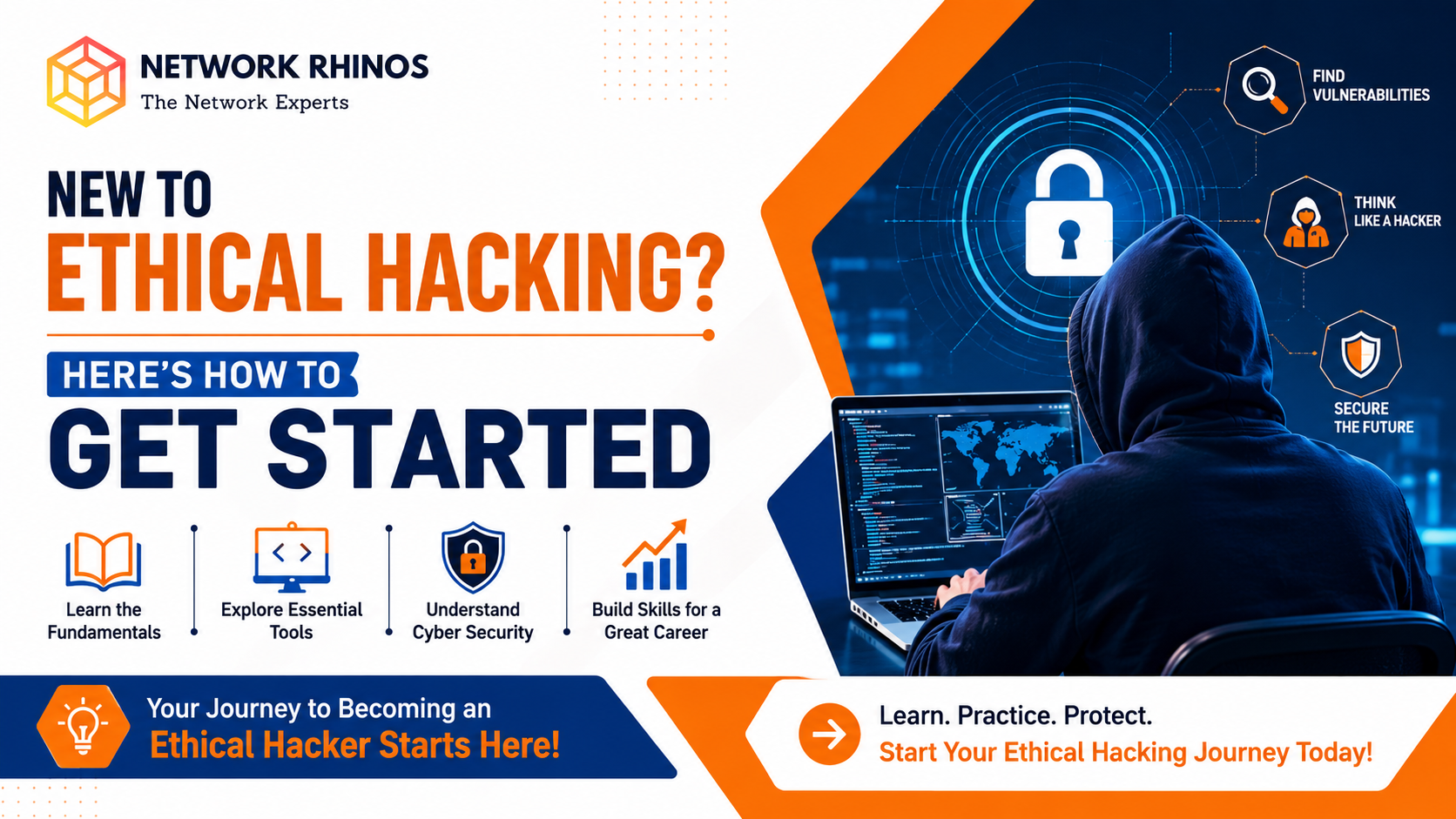
New to Ethical Hacking? Here’s How to Get Started
You’ve probably come across the term ethical hacking while exploring cybersecurity careers. Maybe you’ve seen people working with Kali Linux, testing websites, analyzing networks, or using tools that look straight out of a movie.
But if you’re completely new to the field, it can be difficult to know where to begin.
Do you need to know programming first? Should you learn networking? Do you need a cybersecurity degree? And is taking an ethical hacking course really necessary?
The good news is that you don’t need to know everything before you start. What you do need is a clear learning path and a willingness to understand how systems work.
Let’s break it down.
What Is Ethical Hacking?
Before getting into tools and techniques, it’s important to understand what is ethical hacking in the first place.
Ethical hacking is the practice of legally testing computers, networks, applications, and systems to identify security weaknesses before someone with malicious intent can exploit them.
The key word here is permission.
An ethical hacker does not simply try to break into any system they find. They work with authorization from the organization or system owner and follow an agreed scope while performing security testing.
For example, a company may ask an ethical hacker to test its website and find vulnerabilities that could put customer information at risk. The hacker attempts to identify those weaknesses, documents the findings, and helps the organization understand how to fix them.
So, ethical hacking is not about “hacking anything you want.” It is about using hacking techniques responsibly to improve security.
Why Are More People Learning Ethical Hacking?
Cyberattacks are no longer a problem limited to large technology companies. Businesses of all sizes rely on websites, cloud platforms, applications, databases, and connected networks.
That means there is a growing need for people who understand how these systems can be attacked and, more importantly, how they can be protected.
This is one reason an ethical hacking course for beginners can be a useful starting point for someone interested in cybersecurity.
Instead of trying to learn random hacking tools from different tutorials, a structured course can help you understand the concepts in the right order.
What Should You Learn First?
One of the biggest mistakes beginners make is jumping straight into hacking tools.
You may install Kali Linux, open Nmap or Metasploit, and start following commands without understanding what those commands actually do.
That approach may help you complete a tutorial, but it doesn’t necessarily help you become a good ethical hacker.
Start with the fundamentals.
1. Learn Networking Basics
Networking is one of the foundations of cybersecurity.
You should understand concepts such as:
- IP addresses
- MAC addresses
- Ports and protocols
- TCP/IP
- DNS
- HTTP and HTTPS
- Routers and switches
- Firewalls
- VPNs
- Common network services
When you understand how devices communicate, security vulnerabilities become much easier to understand.
2. Get Comfortable With Linux
Linux is widely used in cybersecurity, and many security tools are built around Linux environments.
You don’t need to become a Linux administrator before starting. Begin with basic commands, file permissions, processes, networking commands, and package management.
Later, you can explore security-focused distributions such as Kali Linux in a controlled lab environment.
3. Understand Security Fundamentals
Before testing a system, you should understand what you are actually looking for.
Learn about:
- Vulnerabilities
- Threats and risks
- Authentication and authorization
- Encryption
- Access control
- Security misconfigurations
- Common attack methods
- Vulnerability assessment
- Penetration testing
This foundation will make the practical side of ethical hacking much more meaningful.
4. Start Exploring Ethical Hacking Tools
Once you have the basics, you can start working with security tools.
Some commonly used tools include:
- Nmap
- Wireshark
- Burp Suite
- Metasploit
- Nikto
- Gobuster
The goal isn’t to memorize hundreds of commands.
Instead, understand why a tool is used, what information it provides, and how the results can help identify a security issue.
Always practise these tools in systems you own or in intentionally vulnerable lab environments where you have permission to test.
How to Learn Ethical Hacking as a Beginner?
If you’re wondering how to learn ethical hacking course content without getting overwhelmed, think of it as a progression rather than one huge subject.
A practical learning path could look like this:
Networking → Linux → Cybersecurity Fundamentals → Reconnaissance → Scanning → Vulnerability Assessment → Web Security → Penetration Testing → Reporting
You don’t have to master every topic before moving forward. The important thing is to keep connecting the concepts.
For example, when you learn about port scanning, your networking knowledge helps you understand what those ports actually represent. When you learn web application security, your understanding of HTTP makes the process much clearer.
That is how your knowledge gradually starts coming together.
Should You Take an Ethical Hacking Course?
You can certainly begin learning from books, documentation, labs, and online resources.
However, beginners often struggle because they don’t know what to learn next.
A structured ethical hacking training program can help by providing a defined curriculum, practical exercises, instructor guidance, and a controlled environment for learning.
When comparing an ethical hacking course, don’t look only at the certificate.
Look at what you will actually learn and practise.
A useful course should ideally cover both fundamentals and hands-on security testing rather than focusing only on theory.
How to Join an Ethical Hacking Course?
If you’re wondering how to join ethical hacking course programs, start by checking a few important things before enrolling.
Look at:
- Course syllabus
- Practical lab sessions
- Trainer experience
- Tools covered
- Certification preparation
- Course duration
- Beginner eligibility
- Support available after classes
If you’re completely new to cybersecurity, make sure the course actually starts with fundamentals instead of assuming that you already understand networking and Linux.
Do You Need Programming to Learn Ethical Hacking?
Not necessarily.
You can begin ethical hacking without being an advanced programmer.
However, learning some programming will become increasingly useful as you progress.
Python, JavaScript, Bash, and SQL can be particularly helpful depending on the area of security you choose.
For example, Python can help you automate repetitive tasks, while JavaScript and SQL can help you understand certain types of web application vulnerabilities.
Think of programming as a skill that you can develop alongside ethical hacking rather than something that must stop you from starting.
Is Ethical Hacking a Good Career?
For someone who enjoys technology, problem-solving, and continuously learning, it can be an interesting career path.
Ethical hacking is not a field where you learn a fixed set of skills and stop.
New technologies, vulnerabilities, attack techniques, cloud environments, applications, and security challenges continue to evolve. That makes continuous learning a major part of the job.
Depending on your skills and experience, cybersecurity professionals can explore roles such as:
- Ethical Hacker
- Penetration Tester
- Security Analyst
- Vulnerability Assessment Analyst
- Web Application Security Tester
- Security Consultant
- Red Team Professional
Your career path will depend on the area you eventually choose to specialize in.
Cyber Security and Ethical Hacking Course: What’s the Difference?
You may also come across courses described as a cyber security and ethical hacking course.
Although the two areas overlap, they are not exactly the same.
Cybersecurity is a broad field covering the protection of systems, networks, applications, data, users, and organizations.
Ethical hacking is more focused on finding and demonstrating security weaknesses through authorized security testing.
In simple terms, cybersecurity is the bigger field, while ethical hacking is one of the practical areas within it.
This is why learning cybersecurity fundamentals before moving deeply into ethical hacking can be valuable for beginners.
What Can You Practise as a Beginner?
Reading about ethical hacking is useful, but practical experience is where things start to make sense.
Instead of testing random websites or networks, create a safe learning environment.
You can practise using:
- Your own virtual machines
- Intentionally vulnerable applications
- Cybersecurity training labs
- Capture-the-Flag challenges
- Authorized practice environments
This lets you experiment, make mistakes, investigate what happened, and try again without putting someone else’s system at risk.
That last part is important: never test a system without permission.
What Does the Learning Journey Look Like?
You don’t need to become an expert overnight.
A realistic progression might look something like this:
Stage 1 – Foundations
Networking, Linux, operating systems, and basic security concepts.
Stage 2 – Security Testing
Reconnaissance, scanning, vulnerability identification, and security assessment.
Stage 3 – Web Security
Understanding web applications, HTTP, authentication, and common web vulnerabilities.
Stage 4 – Practical Hacking
Working with security tools and controlled penetration-testing environments.
Stage 5 – Specialization
Choosing an area such as web application security, network penetration testing, cloud security, red teaming, or another cybersecurity specialty.
The more you practise, the easier it becomes to see how the individual pieces fit together.
Final Thoughts
Getting started with ethical hacking can feel confusing because there are so many tools, technologies, and tutorials available.
Don’t try to learn everything at once.
Build your networking foundation, understand Linux, learn cybersecurity concepts, practise in safe environments, and gradually move into security testing.
A good ethical hacking course for beginners can give you structure, but your curiosity and hands-on practice will ultimately make the biggest difference.
And if you’re considering cybersecurity as a career, don’t focus only on learning how to use hacking tools. Learn why vulnerabilities exist, how systems work, how attacks happen, and how organizations can defend against them.
That’s what turns someone who can follow a hacking tutorial into someone who can actually think like a security professional.