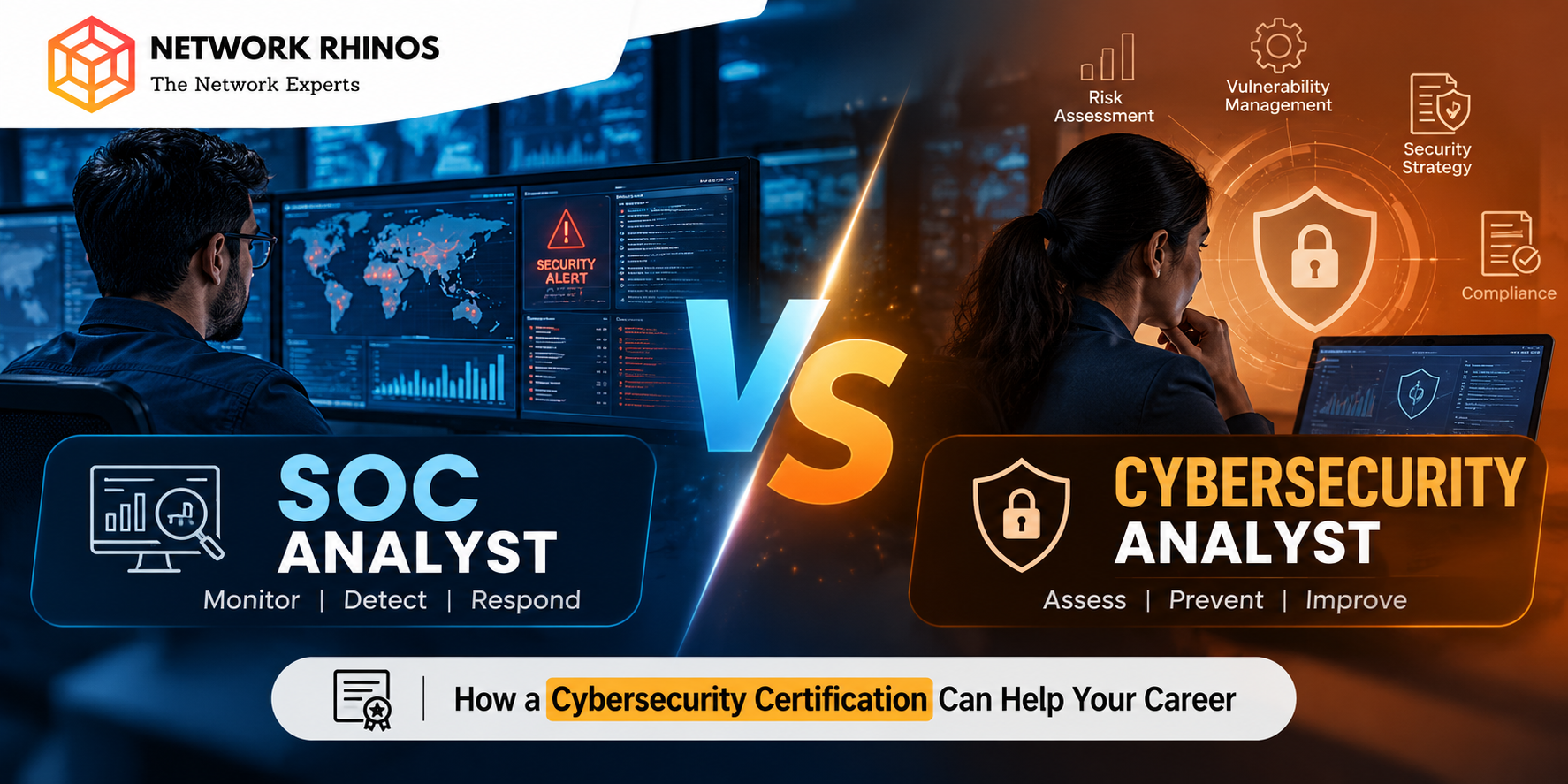
SOC Analyst vs Cybersecurity Analyst: What’s the Difference?
Cybersecurity is one of the fastest-growing areas in the IT industry, and more professionals are exploring it as a career option. But if you are just getting started, you might find yourself confused by job titles such as SOC Analyst and Cybersecurity Analyst.
Are they the same? Do they require different skills? And which career path should you choose?
Although both roles focus on protecting organizations from cyber threats, their day-to-day responsibilities can be quite different. Understanding these differences can help you choose the right career path, develop the necessary skills, and decide whether a Cybersecurity certification is the right next step for you.
Let’s break it down in simple terms.
What Is a SOC Analyst?
A SOC Analyst, or Security Operations Center Analyst, is responsible for monitoring an organization’s systems, networks, and security tools to identify potential cyber threats.
Think of a SOC analyst as a security professional who keeps watch over an organization’s digital environment. They investigate suspicious activity, review security alerts, and help the team respond when something unusual happens.
For example, imagine an employee’s account suddenly attempts to log in from several different countries within a short period. A SOC analyst investigates the activity to determine whether it is legitimate or a possible account compromise.
Key Responsibilities of a SOC Analyst
A SOC analyst’s daily responsibilities typically include:
- Monitoring security alerts from tools such as SIEM platforms.
- Investigating suspicious logins, malware alerts, and unusual network activity.
- Analyzing system and security logs to identify potential threats.
- Identifying false positives and prioritizing genuine security incidents.
- Escalating serious incidents to senior analysts or incident response teams.
- Documenting investigations and preparing security reports.
SOC analysts often work with tools such as Splunk, Microsoft Sentinel, QRadar, and endpoint detection and response (EDR) platforms.
Many SOC positions operate around the clock, so shift work may be part of the job, particularly for entry-level analysts.
What Is a Cybersecurity Analyst?
A Cybersecurity Analyst is a broader role focused on protecting an organization’s digital assets, systems, networks, and sensitive information from cyber threats.
Unlike a SOC analyst, whose work often centers on monitoring and investigating alerts, a cybersecurity analyst may be involved in several areas of security. These can include vulnerability management, risk assessment, security policy implementation, incident response, and security improvement projects.
For example, a cybersecurity analyst might assess a company’s systems to identify outdated software, recommend security improvements, and work with the IT team to reduce the risk of a future attack.
The exact responsibilities depend on the organization. Some cybersecurity analyst positions focus heavily on security monitoring, while others emphasize risk, compliance, vulnerability management, or security engineering.
Key Responsibilities of a Cybersecurity Analyst
Depending on the role, responsibilities may include:
- Assessing security risks and identifying system vulnerabilities.
- Reviewing security incidents and helping coordinate responses.
- Recommending improvements to security controls and procedures.
- Monitoring compliance with security policies and industry standards.
- Supporting vulnerability assessments and security audits.
- Analyzing threats and developing strategies to reduce security risks.
- Collaborating with IT, networking, and other security teams.
Cybersecurity analysts may use SIEM and EDR tools alongside vulnerability scanners, risk assessment frameworks, and security testing tools.
SOC Analyst vs Cybersecurity Analyst: Key Differences
Both roles contribute to an organization’s security, but their primary focus, daily tasks, and career opportunities can differ.
| Comparison | SOC Analyst | Cybersecurity Analyst |
|---|---|---|
| Primary focus | Security monitoring and incident detection | Broader security protection and risk reduction |
| Main responsibility | Investigating alerts and suspicious activity | Identifying weaknesses and improving security |
| Typical tasks | Log analysis, alert triage, incident escalation | Risk assessments, vulnerability management, security reviews |
| Common tools | SIEM, EDR, threat intelligence platforms | SIEM, vulnerability scanners, security assessment tools |
| Work environment | Often within a Security Operations Center | IT security teams, security operations, risk or compliance teams |
| Entry-level opportunities | SOC Analyst L1, Junior SOC Analyst | Junior Cybersecurity Analyst, Information Security Analyst |
| Shift work | Common in 24/7 SOC environments | Depends on the organization and role |
| Career progression | Senior SOC Analyst, Threat Hunter, Incident Responder | Security Specialist, Security Engineer, Security Consultant |
One important point: these job titles are not standardized across every company. A cybersecurity analyst at one organization may perform almost the same duties as a SOC analyst at another.
That is why reading the job description is more useful than relying on the title alone.
Which Role Is Better for Beginners?
If you are entering cybersecurity without much professional experience, a SOC analyst position can be a practical starting point.
SOC teams often have structured processes for investigating alerts, documenting incidents, and escalating complex cases. These tasks can help beginners develop a strong understanding of how cyberattacks happen and how organizations detect them.
However, this does not mean that every SOC job is entry-level or that cybersecurity analyst roles are suitable only for experienced professionals. Some companies hire junior cybersecurity analysts, while others expect candidates to have prior IT or security experience.
Your best starting point depends on your current knowledge and interests.
Choose a SOC analyst path if you enjoy:
- Investigating suspicious activity and solving technical problems.
- Working with logs, alerts, and security monitoring tools.
- Learning how attackers behave and how threats are detected.
- Responding to security incidents in a structured environment.
Consider broader cybersecurity analyst roles if you enjoy:
- Identifying vulnerabilities before attackers exploit them.
- Assessing risks and recommending preventive measures.
- Improving security policies, controls, and procedures.
- Exploring different areas of information security.
If you are unsure, start by learning networking fundamentals, operating systems, basic security concepts, and log analysis. These skills are useful in both career paths.
Skills You Need for Both Roles
Although the daily responsibilities may differ, SOC analysts and cybersecurity analysts share several foundational skills.
1. Networking Fundamentals
Understanding IP addresses, DNS, HTTP and HTTPS, ports, firewalls, and common network protocols is essential. You need to know how systems communicate before you can recognize unusual or malicious activity.
2. Operating System Knowledge
Learn how Windows and Linux systems work, where logs are stored, how user permissions function, and how processes and services operate. These basics will help you investigate incidents more effectively.
3. Security Fundamentals
You should understand malware, phishing, ransomware, authentication, encryption, access control, vulnerabilities, and common attack techniques.
4. Log Analysis and SIEM Tools
For SOC roles especially, learning to investigate logs and work with a Security Information and Event Management (SIEM) platform can give you a useful practical foundation.
5. Analytical and Communication Skills
Cybersecurity is not only about technical knowledge. You must be able to connect evidence, distinguish normal behavior from suspicious activity, document findings clearly, and explain risks to other teams.
Practical experience through cybersecurity labs, guided projects, and simulated investigations can help you demonstrate these skills to employers.
Does a Cybersecurity Certification Help You Get a Job?
A Cybersecurity certification can help demonstrate your knowledge, particularly when you are transitioning from another field or applying for an entry-level position.
However, a certificate alone does not guarantee employment. Employers also look at practical skills, problem-solving ability, relevant experience, and how well you understand the tools and concepts mentioned in their job descriptions.
The right certification depends on your current experience and the role you want to pursue.
For beginners, CompTIA Security+ is a well-known option for learning broad security fundamentals. Google Cybersecurity Professional Certificate is another learning pathway for people who want a structured introduction to cybersecurity concepts and practical activities.
If your goal is to become a SOC analyst, you can also explore training focused on SIEM platforms, security monitoring, alert investigation, and incident response. For broader cybersecurity analyst positions, consider learning about vulnerability management, risk assessment, and security controls.
Before paying for any program, review the syllabus, practical labs, exam requirements, and the skills requested in job postings that interest you.
The goal is not to collect as many certificates as possible. It is to combine relevant learning with practical experience.
Career Growth: Where Can These Roles Take You?
Both paths can lead to more specialized and senior cybersecurity positions.
A SOC analyst may progress into roles such as:
- Senior SOC Analyst
- Incident Response Analyst
- Threat Hunter
- Security Detection Engineer
- Security Operations Lead
A cybersecurity analyst may move toward roles such as:
- Senior Cybersecurity Analyst
- Information Security Specialist
- Vulnerability Management Specialist
- Security Engineer
- Security Consultant
- Governance, Risk, and Compliance Specialist
These paths can overlap. For example, experience investigating security incidents as a SOC analyst can be valuable when moving into incident response or threat hunting. Similarly, experience in vulnerability management can support a transition into security engineering.
Career growth usually depends on practical experience, technical depth, communication skills, and the specialization you develop over time.
Final Verdict: SOC Analyst or Cybersecurity Analyst?
There is no single winner because both roles play important parts in protecting organizations from cyber threats.
If you prefer real-time monitoring, investigating alerts, and understanding how attacks are detected, becoming a SOC analyst may be the right choice.
If you want to explore a wider range of responsibilities, including vulnerability management, security assessments, risk reduction, and security planning, a cybersecurity analyst role may suit you better.
For beginners, the smartest approach is to build a strong foundation in networking, operating systems, and security fundamentals before choosing a specialization. Add hands-on labs and a relevant Cybersecurity certification to strengthen your learning, and use actual job descriptions to guide your preparation.
Remember, your first job title does not have to define your entire career. Both roles can give you valuable experience and open doors to new opportunities in cybersecurity.
Start with the skills that interest you, practice consistently, and build your career one step at a time.
SEO details for publishing
- SEO title: SOC Analyst vs Cybersecurity Analyst: Key Differences
- Primary keyword: Cybersecurity certification
- Suggested URL slug:
soc-analyst-vs-cybersecurity-analyst - Meta description: Discover the differences between a SOC Analyst and a Cybersecurity Analyst, including skills, responsibilities, career paths, and cybersecurity certification options.
- Suggested secondary keywords: SOC Analyst vs Cybersecurity Analyst, SOC Analyst career, cybersecurity jobs for beginners, cybersecurity skills, entry-level cybersecurity jobs.
Frequently Asked Questions
1. Is a SOC analyst the same as a cybersecurity analyst?
No. A SOC analyst generally focuses on security monitoring, alert investigation, and incident detection. A cybersecurity analyst may handle a broader range of security responsibilities, although the roles can overlap.
2. Can I become a SOC analyst without experience?
Yes, some employers offer entry-level SOC positions. Learning networking, Windows and Linux fundamentals, SIEM tools, and incident investigation can help you prepare for these opportunities.
3. Which cybersecurity certification is best for beginners?
CompTIA Security+ and the Google Cybersecurity Professional Certificate are two options worth exploring. Your choice should depend on your learning goals, budget, and the requirements of your target jobs.
4. Which career has better growth opportunities?
Both offer opportunities for advancement. SOC analysts may specialize in threat hunting and incident response, while cybersecurity analysts may move into security engineering, risk management, or consulting.
5. Do cybersecurity analysts need coding skills?
Not every role requires programming. However, basic scripting with Python or PowerShell can help automate repetitive tasks and analyze security data.